


Let’s face it, Burning Man is the biggest occult ritual in the world – outside of organized religion, whose participants probably don’t consider themselves “occult” anyway.
BMOrg, of course, denies this, saying:
…Burning Man was not founded by pagans, and we have never attached any kind of supernatural dogma to its practices. Undoubtedly, the act of pilgrimage to a remote location and the ritual sacrifice of a ceremonial figure has real religious resonance for many people, and any spiritual faith, however arrived at, is certainly worthy of respect. Valid comparisons have also been drawn between events at Burning Man and religious ceremonies in the ancient world — in particular, the observances of the Mystery Religions of the Hellenic and Roman eras. The ritual aspects of Burning Man, however, have wholly evolved in the context of artistic endeavor, and their significance, as with any work of art, is explicitly left open to interpretation.
…Participants in Burning Man tend to be highly educated, often work in the professions, and are likely to be more familiar with the writings of Debord, Baudrillard, and other postmodern intellectuals than with the works of Edgar Cayce
I’m guessing the BMOrg don’t get out much to meet the “common folk” Burners. I’ve never heard discussions about Debord and Baudrillard on the Playa, but I’ve been in plenty about New Age subjects like astrology, the Mayan calendar, 2012, aliens, ancient sites, prophecies, secret history…many Burners seem interested in these topics. As America’s greatest mystic and the founder of the New Age movement, Edgar Cayce is probably quite well known to Burners, much more so than obscure philosophers.
Lee Gilmore is the author of a couple of books about Burning Man and a contributor to the official blog. She is a Burner from way back – 1996. One of Lee’s books, “Theater in a Crowded Fire” explores the ritualistic and spiritual side of Burning Man.
The book sounds quite interesting. From an interview Lee did with herself in 2010:

This decadent ritualism, which can be both sincere and satirical, casts the festival as a semi-religious cultural happening. Furthermore, many participants describe Burning Man as a “spiritual” experience, but deny that it constitutes a new religious movement as such. Organizers too explicitly hope that the event will “produce positive spiritual change in the world,” even while they also stop short of characterizing the event as “religious.”
Every Burner has something different to contribute, and we commend Lee for using her talents in this way.
My work sought to explore the tension between “spirituality” and “religion” in the narratives of Burning Man participants in order to better understand how religio-cultural systems operate and adapt.
As a venue that emphasizes creativity and participation, Burning Man often inspires people to contribute their own unique talents and visions to the event. My particular art form is the academic study of religion and the practice of writing, so I see this book as my way of participating with the community.
For those who might be wondering, Burning Man is not just about sex, drugs, and dance music:
Burning Man is a veritable magnet for misconceptions… I think the biggest is to brand Burning Man as nothing more than a giant party rife with intoxicants, nudity, and bald hedonism. While it would be dishonest to claim that those elements are not present, they are neither as widespread nor as central to the event as many might assume. I think the easy stereotypes miss something much more important and interesting in how the event genuinely strives, and often succeeds, to be much more. Burning Man provides opportunities for deep reflection on intersections of self, community, and culture; and in so doing provides a venue in which to seek transformation for both the self and beyond. I also think it is symptomatic of America’s puritanical heritage to attempt to strip away the festal or carnivalesque elements of religion from what some might consider to be “authentic” piety. But historically and cross-culturally, opportunities for celebration are often part of the “package deal” that religions offer.
So what, exactly, is the spiritual nature of Burning Man? It seems that’s it’s different for everyone, not noticed by some, but shared by many. From another article by Lee Gilmore:

For Burners, spirituality is fundamentally experiential (based on the primacy of personal experience and personal authority in framing those experiences), reflexive (inspiring reflections on self, self/other, self/nature, and self/culture), and heterodoxic (constituted by multiply-layered, fluid, and non-centralized constructions of meaning). But troubling any simplistic conclusions, many other participants state most emphatically that Burning Man does not entail any sense of spirituality—even while some of these same individuals also engage in expressive, ritualized quests for self-discovery through the event, but which they elect not to cloak in mystical terms. Furthermore, some observers and participants alike deny that this festival has any redeeming qualities whatsoever, seeing it as merely an excuse for debauchery and a license for transgressive behavior that is disconnected from any overt spirituality. Yet while the event is undeniably rife with opportunities for hedonistic indulgence, it would be mistaken to understand hedonism as anti-religious. Dismissals of Burners as pleasure-seekers reveal the deep and lasting imprint of America’s ascetic Protestantism. Furthermore, religious traditions that are utterly bereft of some opportunity for joyous, and occasionally excessive, celebration as part of the package deal are comparatively rare.
If there’s any religion at Burning Man, it’s Pagan:

…inasmuch as paganism is the root of religion, it confronts the earliest, the most immediate, and the least processed apprehensions of the sacred. This is the experiential level on which paganism in both its indigenous and contemporary forms wishes to concentrate.” (see York’s Pagan Theology)
Not everybody is down with the Wicca magickal, occult ritualistic elements of Burning Man. Some, like Thomas Horner, see it as a sign of the End of Times:
In the U.S., the number of earth-worshipping pagans at the Burning Man Festivals have grown to tens of thousands. People come from Canada, Brazil, Germany, Russia, and 25 other countries to an isolated corner of Black Rock Desert in Nevada, where other Wiccans, Satanists, goddesses, nudists, and a consortium of party-goers converge on the hot Nevada desert for a Labor Day weekend of “glorious Hell on earth.”
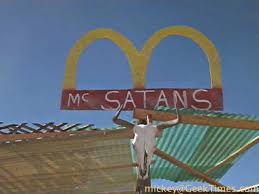
The 40-foot-high effigy Burning Man (the “Spirit Cave Man”– sacred to local Indians and New Agers) will be torched as usual together with just about everything else at the close of the festivity.
powerful and ancient entities are behind the revival of paganism. In the air above and the earth beneath are nefarious progenitors of esoteric mysticism. “Demons” to some and 
- Aphrodite—sensuality, fertility rites, wiccan rituals, sacred prostitution.
- Amun-Ra—masturbation, self realization, environmentalism, Darwinism.
- Apis—animal worship, animal rights, animal channeling, occultianity.
- Apollo—humanism, oracles, channeling, psychics, drugs, visualization.
- Artemis—goddess worship, animal worship, animal rights, lesbianism.
- Asclepius—holistic medicine, psychic dreaming, spirit-guide animals.
- Athene—goddess worship, feminism, the spirituality movement, lesbianism.
- Baal—oracles, polytheism, abortion, fertility issues.
- Demeter—environmental education, earth worship, goddess worship.
- Dionysus—drunkenness, freudianism, ecstasy, pornography, lesbianism, abortion.
- Eros—eroticism, mystic sex, body worship, body piercing, sacred prostitution.
- Gaia—earth worship, environmentalism, paganism, pantheism, sweat lodges.
- Geb—environmental movement, animal rights, eco-paganism.
- Hades—devil worship, occultism, spiritism, necromancy.
- Hathor—goddess worship, earth worship, animal rights, animal worship.
- Hecate—witchcraft, necromancy, crystals, spells, druidism, feminism.
- Heka—mysticism, demonism, animal rights, environmentalism.
- Hypnos—hypnotism, psychic dreaming, prognostication, e.s.p., clairvoyance.
- Imhoteb—mystic healing, animal dancing, holistic medicine, vision quests.
- Isis—wicca, witchcraft, goddess worship, magic, channeling, visualization.
- Min and Qetesh—fertility rites, body worship, sensuality, pornography.
- Osiris—occultianity, necromancy, anthropomorphism, occultism, spiritism.
- Persephone—animism, zoroastrianism, dualism, magic, necromancy.
- Ptah—universalism, pantheism, mysticism, holistic medicine.
- Sekhmet—environmentalism, mystic medicine, animal worship.
- Seth—homosexuality, rebellion, earth worship, environmental movement.
- Vatchit—devil worship, channeling, trancing, visualization, necromancy.
- Zeus—Satanism, transexualism, pantheism, oracles, animal worship.
By whatever names they may otherwise be called, the underworld spirits elevated in the Burning Man and Occulture festivals are gathering the combined efforts of the kingdom of Satan toward a conspiracy of apocalyptic proportions. As a consequence, we are experiencing an unprecedented pagan revival at a time when the United States and Britain are considered the most advanced economic and technological powers in the world.
I’m not sure about the Apocalypse, but I have definitely experienced Rapture at Burning Man – on many occasions. And both Toburn and I have encountered Dionysus on the Playa, perhaps in his Italian incarnation…
It’s good to see lots of female entities in there for us to worship, so it’s not all about bowing down to The Man.

Take Our Poll