


ekoVillages.com upcycled art container
So if Google are thinking to make their Google Glass and other new technologies “cool” by getting a Burner vibe on their barges, they’re in the right place. Burning Man is a major user of shipping containers, containers and Burners go hand in hand. Will the barge be a Temporary Autonomous Zone? One that is free to set its own rules and laws, once towed out to international waters? San Francisco’s Bay could definitely use more cruising destinations for the 50,000+ boats kept here.


Here’s what the NYT had to say:

The barges, four stories tall and made of shipping containers, were hiding in plain sight until last month, when a Cnet reporter uncovered their cloaked connection to Google. Reports have speculated that the barges could be floating data centers, traveling Google Glass stores or showrooms with party decks.
On Wednesday, Google issued its first statement on the matter, hinting that the barges are showrooms for new technology, which could include Glass.
“Google Barge … A floating data center? A wild party boat? A barge housing the last remaining dinosaur?” the statement said. “Sadly, none of the above. Although it’s still early days and things may change, we’re exploring using the barge as an interactive space where people can learn about new technology.”
The statement brought to mind comments made by Larry Page, Google’s co-founder and chief executive, at its I/O developers conference in June. He acknowledged that people often have a visceral, fearful reaction to new technology and fantasized about a place to experiment with new products.
“People are naturally scared of change,” Mr. Page said. “We haven’t built mechanisms to allow experimentation.”
“There’s many, many exciting and important things you could do that you just can’t do because they’re illegal or they’re not allowed by regulation,” he lamented. “And that makes sense, you don’t want our world to change too fast. Maybe we should set aside a small part of the world — I like going to Burning Man, for example — that’s an environment where people can try out different things.”
So will the barges be a place for Google to ease people into new technology? Are they going to be like Burning Man at sea? And how far off the coasts would Google’s barges have to float to escape all those pesky laws and regulations?
The answer to the last question is 22 kilometers, or not quite as far as the Farallon Islands.
Google denies that the barge will be a wild party boat. Which, as a public company, they probably have to. Still, everyone’s definition of “wild” is a little bit different…I say let’s get some DJs, lasers and Funktion1’s and fire that bad boy up!
There is already a floating party in the SF Bay, the annual Ephemerisle at the Sacramento river delta. It is put on by the Seasteading Institute, who very much support the idea of Temporary (and Permanent) Autonomous Zones. There’s a great article about the event at N Plus One, here are some excerpts:
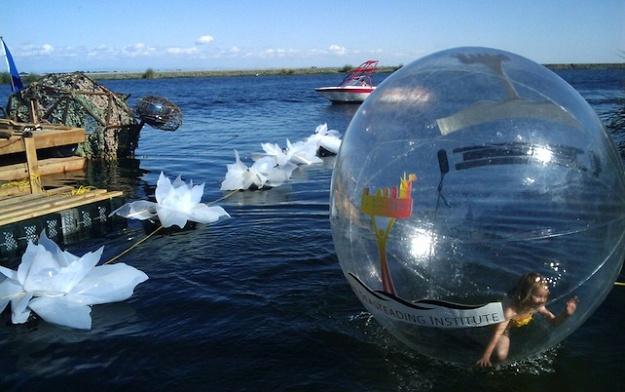
It looked, at first, like a shapeless pile of floating junk, but as the boat drew closer, a sense of order emerged. The island was made up of two rows of houseboats, anchored about a hundred feet apart, with a smaller cluster of boats and yachts set off to the west. The boats had been bound together with planks, barrels, cleats, and ropes, assembled ad-hoc by someone with at least a rudimentary understanding of knots and anchors. Residents decorated their decks with banners and flags and tied kayaks and inflatable toys off the sides, giving the overall landscape the cephalopodan quality of raver pants. Dirty socks and plastic dishes and iPads and iPhones littered the decks. An enormous sound system blasted dance music, it turned out, at all hours of the day.

If it sounds a lot like Burning Man, that’s no coincidence. The founders of the Seasteading Institute are Burners, as is PayPal and Facebook Kingmaker Peter Thiel, who wrote a $1.25 million check to the Institute.

Ephemerisle got its libertarian streak from its founders: the event was originally conceived of by the Seasteading Institute, a San Francisco nonprofit that supports the creation of thousands of floating city-states in international waters. After overseeing the first Ephemerisle in 2009, the Institute handed over responsibility for the festival to the community in 2010—it turns out a raucous floating party costs too much for a tiny think tank to insure—and last year, the group consisted of 300 amateur boaters, intoxicated partiers, and a committed clan of Seasteaders.

[Update 11/11/13] After we published this story last week, Google went to the Chronicle to reveal their plans for the barges. 
The barge portion of the Google barge mystery is only half the story — when completed, the full package is envisioned to be an “unprecedented artistic structure,” sporting a dozen or so gigantic sails, to be moored for a month at a time at sites around the bay.
Documents submitted to the Port of San Francisco show that the barge’s creators have big plans for the bulky box now docked at Treasure Island.
When it’s done, the barge’s backers say, the 50-foot-tall, 250-foot-long structure made of recycled shipping containers will be flanked by sails “reminiscent of fish fins, which will remind visitors that they are on a seaworthy vessel.”
“The structure will stand out,” the team says, in what is probably an understatement.
By and Large LLC, which submitted the barge documents, refers to the vessel as a “studio” and “temporary technology exhibit space.” It says its goal is to “drive visitation to the waterfront.”
The barge’s exhibit space, it says, will be for “local organizations to engage with guests and gain visibility in a unique way.”
“We envisioned this space with community in mind,” By and Large says, “a surprising environment that is accessible to all and inspires conversation about how everything is connected — shorebirds, me, you, the sea, the fog and much more.”
Exactly who is By and Large? That’s a little unclear, but it’s reported to be firmly connected to Google. Some have noted that it looks like a play on the word “barge.”
Google has been largely closed-mouthed about its waterborne behemoth. After rumors circulated that it was going to be a showroom, a floating data center that could be used in the event of a natural disaster, or perhaps a big party boat, the company issued a statement Wednesday calling it an “interactive space where people can learn about new technology.”
Asked to comment Thursday on the planning documents, which we obtained from the port under the Freedom of Information Act, Google officials sent us the same brief statement they issued a day before.
Whatever it is, the barge’s backers expect it to draw 1,000 visitors a day as it sails from spot to spot around the bay. Among the envisioned mooring sites are Piers 30-32 and other San Francisco docks, Fort Mason, Angel Island, Redwood City and Rosie the RiveterHistorical National Park in Richmond.
The idea is to stay at each spot for a month. Eventually, the barge would sail off to San Diego and other West Coast ports.
San Francisco Port spokeswoman Renee Dunn Martin said the pitch, which By and Large submitted in September, was “part of a preliminary proposal. They haven’t come back to us with anything concrete.”
Talks appear to have stalled over the glacial permit approval process before the Bay Conservation and Development Commission.
As for the sails — By and Large says that in addition to reminding people they’re on a boat, they would “provide shade and shelter to guests.” They would be lowered in bad weather. One artist’s rendering submitted to the port appears to show the sails lit up at night.
“We believe this curious and visually stunning structure will be a welcome addition to the waterfront, an experience unlike any other,” the proposal says.
The design was drawn up by a pair of internationally known architectural firms — the San Francisco outfit Gensler, whose projects include Terminal 2 at San Francisco International Airport, and LOT-EK of New York.
And don’t even think about taking any souvenirs off the barge. It would be equipped with 50-plus security cameras.
“The artistic structure combines innovative architecture with a bit of nautical whimsy,” says the proposal, “creating a surprising environment that inspires conversation, community and ‘a-ha’ moments.”
From the looks of things, it certainly will.