Let’s Do This!
An epic performance from Sammy Davis, Jr from the 1969 movie Sweet Charity looks very much like a precursor to Burning Man. He is a preacher, singing about his new church which is sweeping the nation. It contains so many elements that make it look familiar to Burners – art cars, furry sleeveless vests, indulgent principles, a satire on Judeo/Christian religion, acid culture, weed, Pied Piper…is that the Merry Prankster’s FURTHR bus lurking in the shadows? Hit the floor and crawl to Daddy!
At the time he made this, Sammy Davis Jr was in his prime. He was a member of the “Rat Pack” with Shirley Maclaine, Marilyn Monroe, Dean Martin and Frank Sinatra. They were also known as the “Clan” (presumably with a C not a K) or “The Summit”.
In addition, Sammy Davis, Jr just happened to be a celebrity superstar promoter of the Church of Satan – doing for Anton LaVey what Tom Cruise and John Travolta do today for the Church of Scientology. Blonde bombshell actress Jayne Mansfield, the Paris Hilton or Kim Kardashian of her day, was another star Satanist.

Jayne Mansfield takes the “sacrament” from Anton LaVey
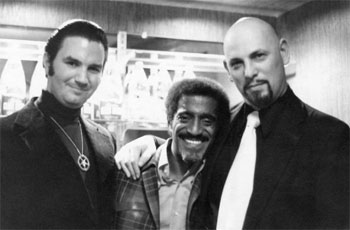
Michael Aquino, Sammy Davis Jr, Anton Lavey. Image: VICE

Sammy made a pilot in SF for this 1973 TV series. It was the plot of “It’s a Wonderful Life” in reverse. Image: VICE
As we explored in Shadow History Part 3 – Satan’s Birthday Party, there is almost no philosophical separation between scientism, satanism, and the values of Burning Man. In Part 4 – Occult Rituals of the Cult we show how Burning Man’s own origins are from San Francisco’s occult scene, a nude beach about a block from the Church of Satan HQ, next to the Presidio Psyop Base (Part 2). Right after Burning Man moved to the desert, the Psyop HQ moved down to Moffett Field, home of Google, Yahoo, Lockheed Martin, NASA Ames, the Singularity University, and many other spooky proponents of transhumanism. The World Wide Web then sprang up around it and became the core of Silicon Valley, as we explored in Part 1 – The Shadow History of Silicon Valley.
Larry Harvey called Burning Man “a compelling physical analog for cyberspace”, in a 1997 Macworld “Digital Be-in” talk.
Another video surfaced this week, which I posted on our Facebook Page. Apparently Walt Disney and Salvador Dali teamed up in 1945 to create a trippy surrealist desert adventure called “Destino”, based on a Mexican folk song.
Once again, we see similarities to Burning Man. Desert, mountains in the distance, cracked playa, bicycles, art cars…we have a lot of themes converging here. Humans merging with gods to create hybrid species; dancing through the wheel of time; dancing and metamorphosis, leading to love. It is dripping with occult symbolism, pyramids, all seeing eyes and so on.
Although Disney and Dalí did collaborate, most of this video was created much later. Still, it looks like Disney and Dalí imagined Burning Man in World War 2…yet another link into the vast occult empire which is Disney Corporation.
[Source]
World War 2 ended when Germany surrendered in May 1945 and the Japanese surrendered in August 1945. They were making the “notes and storyboards” for 8 months into 1946, which shows that the war had ended before this project even began.
What were the “secrets of the film” which Hench knew, but Dalí didn’t? Surely Dalí was the big name in this collaboration?
The work of painter Salvador Dali was to prepare a six-minute sequence combining animation with live dancers and special effects for a movie in the same format of “Fantasia.” The characters are fighting against time, the giant sundial that emerges from the great stone face of Jupiter and that determines the fate of all human novels. Dalí and Hench were creating a new animation technique, the cinematic equivalent of Dali’s “paranoid critique”…inspired by the work of Freud on the subconscious and the inclusion of hidden and double images.
The plot of the film was described by Dalí as “A magical display of the problem of life in the labyrinth of time.”
Walt Disney said it was “A simple story about a young girl in search of true love.”
[Source]
Seems like all the usual stuff, mass media mind control, as above/so below, hidden images, black magick, the subconscious and the soul…
Dalí’s technique is more formally known as the Paranoid Critical Transformation Method, and is one of his biggest claims to fame.
Of all the Surrealists and their achievements, there is one that stands out above all the others. The Paranoiac Critical method was a sensibility, or way of perceiving reality that was developed by Salvador Dalí. It was defined by Dalí himself as “irrational knowledge” based on a “delirium of interpretation”. More simply put, it was a process by which the artist found new and unique ways to view the world around him. It is the ability of the artist or the viewer to perceive multiple images within the same configuration. The concept can be compared to Max Ernst’s frottage or Leonardo da Vinci’s scribbling and drawings. As a matter of fact, all of us have practiced the Paranoid Critical Method when gazing at stucco on a wall, or clouds in the sky, and seeing different shapes and visages therein. Dalí elevated this uniquely human characteristic into his own art form.
Dalí, though not a true paranoid, was able to simulate a paranoid state, without the use of drugs, and upon his return to ‘normal perspective’ he would paint what he saw and envisioned therein.

Image: Wikipedia
Being a painter of miraculous skill, he was capable of reproducing his myriad fantasies and hallucinations as visual illusions on canvas.
.
Dalí was hallucinating, but without drugs. This is certainly possible – the psychiatric justification for the development of LSD and other suggestogens was to “mimic psychosis”. The name “psycheto-mimetics” was discarded as not marketable by Humprhey Osmond and Marshall McLuhan – the Madison Avenue PR guru who also came up with Timothy Leary’s famous “Tune In. Turn On. Drop Out” tagline (though Leary also claimed he came up with it in the shower after meeting McLuhan)
It’s also quite possible that Dalí was tripping on something and just didn’t promote it in media interviews.
Here’s the video set to Pink Floyd’s classic “Time” from Dark Side of the Moon:
The word “Transformation” sure seems to come up a lot in looking at this Presidio/Esalen/Disney/Stanford/Burning Man cluster. This week I discovered that Dr Michael Aquino’s MindWar concept was heavily influenced by Esalen’s Transformation Project think tank.
Burning Man director Chip Conley, whose ambition is to leverage massive amounts of exclusive Burning Man content to make Fest300 the Expedia of festivals, is a trustee of the Esalen Institute. Burning Man holds their corporate retreats there, and it appears to be the model for their Fly Ranch philosophy center plans. Esalen is the occult research base of DARPA. Aquino says they had better stuff than even the CIA or DIA:

Whose project was this in 1996, before Helco?
Of course, there are other occult pop-culture influences on Burning Man, which we have covered over the years.
The Wicker Man (1973)
The Twilight Zone – The Burning Man
The Legend of Billy Jean starring Peter Coyote (Pat Benatar’s Invincible was the theme song)
Pink Floyd: Wish You Were Here
“The Burning Man”, by Storm Thorgeson (1976)


It’s a tough market these days, so the world’s canniest investors are turning to new sources of wisdom. Not Black Rock, the world’s largest asset manager with $4.7 trillion… but the Black Rock Desert, with Mr All Teeth-No Hat himself, Larry Harvey. I heard about this story last night from a banker in Dubai.
So, when Burning Man is being discussed in a paper literally dedicated to trade in commodities – have we reached Commodification yet?
Some might consider Larry a surprising choice to be dispensing wisdom to FT readers. He recently gave his $40 million company away after 30 years, but not before he spent millions of dollars on accountants and lawyers valuing it. They got 2 separate valuations, and then chose to price it at the lower one. Perhaps they were Satanically pranking themselves.
Still, when it comes to eating Shrimp Louis and waxing poetical, Larry’s there to please. Read the whole interview at FT, I want to comment on a couple of things of particular interest to Burners.

Image: Financial Times © James Ferguson
[John’s Grill’s] wood-panelled walls are lined with photographs of famous diners, from Alfred Hitchcock to Steve Jobs. It has survived the 1960s counterculture revolution, half a dozen earthquakes and several cycles of tech industry boom and bust. So too has another San Francisco institution, Larry Harvey. “Well, this is an old-line place, isn’t it?” he says, as I greet him at the back of the restaurant. “It smells like leather and old men.”...
Placing his water bottle between us and with his embroidered black shirt pockets stuffed with cigarettes, notebook and spectacles, he has aged like a Rolling Stone…Harvey says, “I don’t drink much alcohol” but encourages me to “have a drink or two. You might write a more sympathetic story.” …He asks me about Brexit…
“It’s not unlike what’s happening here,” he says. “Fortunately it looks as if the republic isn’t ready to be ruled by a narcissistic celebrity.” A “life-long Democrat”, Harvey is confident that Hillary Clinton is going to sweep Donald Trump to a “historic defeat”. “It’s worked out so beautifully. Bernie [Sanders] pushed her to the left significantly.”
So much for the Mainstream Republican Values of Burning Man. And indeed, the Progressive Left values of the many Sanders supporters I know amongst the Burner community.
Harvey himself is unperturbed by the growing presence of tech billionaires at Burning Man, describing them as “our cousins and neighbours”. It is “ludicrous” to say that money — which is banned from the festival other than to pay for ice and coffee from the Center Camp Cafe — is evil. “We’re not the Occupy movement,” he says, gesturing with half a hard-boiled egg that he has been holding for several minutes. “Civilisation and commerce have always gone hand-in-hand. We’re an international city, for God’s sake. You don’t whistle that up out of nothing.”…Progress comes from “struggle, shared with others, towards some common goal,” he says. “It doesn’t come from love per se.”…Harvey is an atheist and declares himself allergic to the supernatural…At the festival, the burning of the man brings everyone together in a moment of catharsis. “They witness themselves, and they too feel real and themselves, this supercharged entity and yearning, because they’ve been circling around the centre in this chaotic whirl for days,” Harvey says. “Everyone feels like they’re one with everyone else … That’s called transcendence.”
See, I always thought I was living in a community when I was at Burning Man. I didn’t realize that the important thing was everybody circling around this Central Intelligence Axis, summoning a supercharged entity from the chaos. It’s a very binary thing: you can go clockwise, or counter-clockwise. Go with the flow, or stop and it will wash over you. Of course, that’s not supernatural or anything. Burning an effigy in a pentagram, after lighting it from a cauldron called The Devil, burning a Temple, nothing to do with anything supernatural.
I’m not sure that “for God’s sake” is the best phrase to use when asserting one’s atheism.
Here’s what Burning Man was like when I first went. I think many of us old school Burners still see Burning Man this way.
Maybe Larry’s going to FT seeking some new suckers financial heavyweights to chip in for the next phase of their real estate ambitions:
It takes me a long time to get Harvey to address why the festival that puts “leaving no trace” among its core values is using donations to buy a permanent home on a Nevada ranch earlier this year — not least when its founder also bemoans the “imperial sway” of private property. Several tech entrepreneurs — including a founder of Airbnb and a venture capitalist who backed Twitter and Snapchat — donated $6m to Burning Man so it could buy Fly Ranch, a 3,800-acre property.
Some donors asked to remain anonymous; Harvey acknowledges (but does not deny) speculation that they might include the Google boys, who have been spotted hanging out at First Camp, or Elon Musk. But he insists that they have been promised “nothing” in return — “not a role in governance, not tickets … It’s a gift.”
With a “no-hustle” fundraising model established, Fly Ranch is not the limit of Harvey’s ambitions: the group is now eyeing the adjacent Hualapai Flat, a playa not unlike Black Rock’s, which Harvey says is on the Department of the Interior’s list of “disposable properties”. “We’ll be first in line to bid for that.”
While he insists there is no set business plan, Harvey envisions Fly Ranch to be an “auxiliary space” — the “minor key” to the “major key” of the big burn, which, he concedes, can be a “brain-numbing and eardrum-abusing experience”.
Retirement villages in the desert? Will there be beachfront property on this playa? I am ROFLing at the thought that nobody from Google gets tickets from BMOrg. Numb your own brain.

Investors in the new Timeshare at Flysalen may want to consider insurance or a hedging strategy. Seems like Larry’s been watching Doomsday Preppers:
I ask if he feels, after 30 years, that Burning Man’s ideals are starting to be felt beyond the desert. “I’d like to mischievously quote Milton Friedman,” he says, invoking the rightwing economist. “He said change only happens in a crisis, and then that actions that are undertaken depend on the ideas that are just lying around.” With the “discontents of globalisation” set to continue, he predicts that crisis will hit by the middle of this century. “I think there really is a chance for sudden change.” However, I struggle to pin him down on exactly which Burners’ ideas he hopes will be “lying around” when it does…he is much more eager to talk about organisational details, such as Black Rock City’s circular layout, “sort of like a neolithic temple”.
Indeed, Harvey insists he has a “conservative sensibility” and is “not a big fan of revolution”. “Do I sound like a hippie? I’m not!” And he bristles at being called anti-capitalist, although he hung out with the hippies on Haight Street in 1968. “I was there in the spring, autumn and winter of love, but I missed the summer,” he says, due to being drafted into the US army. “It was apparent to me that it was all based on what Tom Wolfe called ‘cheques from home’. The other source that shored it up was selling dope. I thought, that isn’t sustainable.”
We heard last December that Burning Man was going to turn over a new leaf in environmental sustainability. I’m still waiting to see what this actually means. They got a donation from Solar City?
Projects like this suggest we are heading in the opposite direction from sustainability and Decommodification:

Image: SFist, Big Imagination (Facebook)
Is this art, spreading the ideals of the community to make the world a better place? Or just a fancy way to get your signage on TV?
How will this help when the shit hits the fan and civilization collapses? We will all live in converted 747s?
Not to worry, though. Time and space dance to Larry’s tune:
Read the full story at the Financial Times