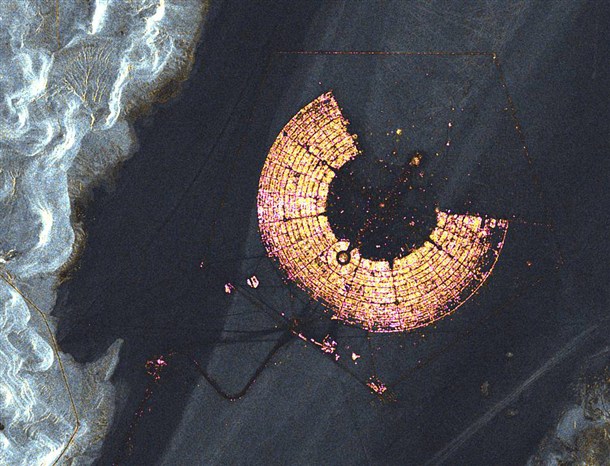
Black Rock City sure is pretty. Although this looks like a night image, it is actually thermal satellite imaging. Burning Man is full of lights, but not all of them are on all the time at every camp.


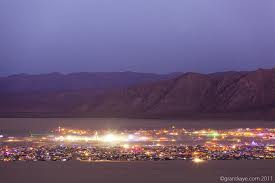
Photo NK Guy, 2009

Thanks to Gizmodo for sharing some stiff competition from this spectacular planet…
The Landsat satellites have been watching Earth uninterruptedly for a record 40 years. During that time they have acquired millions of amazing images of our home world, available for everyone in the planet. These are the five most beautiful ones, according to NASA.
These natural works of art make our blue marble look like an alien planet.
5th Place: Lake Eyre Landsat 5 Acquired 8/5/2006
The scary face in this image is actually inundated patches of shallow Lake Eyre (pronounced “air”) in the desert country of northern South Australia. An ephemeral feature of this flat, parched landscape, Lake Eyre is Australia’s largest lake when it’s full. However in the last 150 years, it has filled completely only three times.

4th Place: Algerian Abstract Landsat 5 Acquired 4/8/1985
What look like pale yellow paint streaks slashing through a mosaic of mottled colors are ridges of wind-blown sand that make up Erg Iguidi, an area of ever-shifting sand dunes extending from Algeria into Mauritania in northwestern Africa. Erg Iguidi is one of several Saharan ergs, or sand seas, where individual dunes often surpass 500 meters (nearly a third of a mile) in both width and height.

3rd Place: Meandering Mississippi Landsat 7 Acquired 5/28/2003
Small, blocky shapes of towns, fields, and pastures surround the graceful swirls and whorls of the Mississippi River, the largest river system in North America. Countless oxbow lakes and cutoffs accompany the meandering river south of Memphis, Tennessee, on the border between Arkansas and Mississippi.

2nd Place: Yukon Delta Landsat 7 Acquired 9/22/2002
Countless lakes, sloughs, and ponds are scattered throughout this scene of the Yukon Delta in southwest Alaska. One of the largest river deltas in the world, and protected as part of the Yukon Delta National Wildlife Refuge, the river’s sinuous waterways seem like blood vessels branching out to enclose an organ.

1st Place: Van Gogh from Space Landsat 7 Acquired 7/13/2005
In the style of Van Gogh’s painting “Starry Night,” massive congregations of greenish phytoplankton swirl in the dark water around Gotland, a Swedish island in the Baltic Sea. Population explosions, or blooms, of phytoplankton, like the one shown here, occur when deep currents bring nutrients up to sunlit surface waters, fueling the growth and reproduction of these tiny plants.

Images by NASA/USGS Landsat. Photo captions by Ellen Gray.
via The Five Most Beautiful Photographs of Earth According to NASA.
Help others find Burners.Me