Burning Man Spin-Off Makes Solid Debut

Further Future, a festival in the Nevada desert put on by the crew behind the Robot Heart art car, happened last weekend about 40 minutes outside of Las Vegas.

It takes a lot of time, effort, money, and logistics to get a major sound stage to the Playa every year. In the case of Robot Heart, the situation is even more complicated because the stage moves around. Once Robot Heart parks and the music gets going, it’s kind of stuck – because of the crowd of 10,000+ people and 100+ art cars surrounding it. It’s hard enough moving out of there on foot, let alone turning the main stereo off and driving away.

What do these sound camps get, from bringing what to many is one of the fundamental elements of Burning Man? Nothing. No money. Barely even thanks. Instead they get Larry & Co bitching because they posted DJ set times, BMOrg complaining about the infrastructure headaches (for example, large numbers of people far away from portapotties), and they have to pick up literally tons of MOOP left by the Bucket List Broners.

Given all that, it’s not at all surprising that sooner or later sound camps say “we might as well do this professionally, with higher standards of safety and sanitation, and get paid for it too”. There is a long history of sound camps throwing year-round events off Playa to raise funds that facilitate bringing their equipment, DJs, and crews out. In this sense Robot Heart are no different, and have been throwing parties for many years.

Further Future went, well, further…with a selection of luxury amenities on offer for those who could afford it. The Robot Heart camp contains several billionaires, but you don’t have to be one to dance at their bus or attend their festival. Some of the online detractors have made a big deal about the “invite-only” nature of the event, but that seems to me a wise move to keep initial numbers controllable. For a first-time event, anything could go wrong, and probably will – better to have 3,000 disgruntled patrons, than 50,000. Although there were some hiccups, Further Future generally went pretty smoothly, and was very much enjoyed by most of the attendees. It was not difficult to get an invitation, regardless of body type or financial status.

The venue was changed at the last minute, after the Bureau of Land Management rejected a permit to use a access road to the festival site “out of the blue”. They chose the same medical provider as Burning Man, Humboldt General Hospital – who then got ditched by Burning Man, a decision that also came “out of the blue”. We know that BMOrg have a cozy relationship with the Bureau of Land Management in Nevada, who they pay millions of dollars a year to. BLM Special Agent Dan Love, who has a long history with Burning Man, appeared near Las Vegas running the historic Bundy Ranch Standoff. Apparently there was more than a little hatred directed towards Further Future at last month’s Global Leadership Conference.

Were these two surprise decisions – that occurred at about the same time and both related to possible competition for Burning Man – completely unrelated coincidences? Or was there some behind-the-scenes Nevada politicking going on?

On April 21 the Reno Gazette Journal said:

Burning Man CEO Marian Goodell and other top Burning Man officials this week are speaking on behalf of the Burning Man nonprofit while in Washington, D.C.

Officials are meeting with both federal and state BLM representatives, asking that they consider issuing a permit that would allow for an increase in attendance starting in 2017.

On April 18 the Las Vegas Review Journal broke the news Further Future Festival Scrambles For New Location. So in the same week that BMOrg are meeting with BLM state representatives and their bosses in DC, the BLM decides to make life hard for Further Future. Hmmm…

Luckily for Further Future, the Moapa Indian tribe stepped up, and provided a site that was bulldozed flat in 10 days for the event.

The festival received a lot of publicity, the reviews were mostly positive:

LA Times: Further Future Goes Deep Into The Desert For A New Kind Of Festival

Las Vegas Weekly: No Sleep Till Further Future: My Night At the Electronic Music Festival

Vice: Further Future’s Debut Proves You Can’t Buy Instant Vibes

Mixmag: Snapped: Further Future in the Nevada Desert

Forbes: Burning Man’s Cool Kids Break Off To Mix Music And Tech At New Festival

The Huffington Post published an interview with FFFounder Robert Scott:

Tell me about the inception of Further Future. Who’s the core team? How did it come about and what inspired the name?

Robert: The main members of the core team with whom the public and industry will generally interact are Jason Swamy, Michael Calabrese and Benjamin Alexander and I. As individuals our team members generally prefer to remain somewhat in the background, with our focus being on benefiting the development of the endeavor and the community over our own personal status, if that makes sense. The Further Future concept is something that we have been talking about and evolving for several years. A Further Future event aspires to be a gathering of people with the common goal to spend time together celebrating the infinite possibilities of the future, without necessarily being shackled to the dictates of the past or the cycles of present-day society. We want to combine the connective power of music and art to bring people together in a place where they can shed their anxieties and fears, and touch a natural state of happiness. This, while immersing ourselves together in a culture of open thought and inquiry sharing ideas and aspirations with leading minds in the fields of art, business, science, technology and thought.

We feel there is a yearning in our world for a mindful and directed optimism, the sort of self-belief that empowers a society to transcend its flaws and scars and make great leaps into the future. We have also in our own lives been drawn to and awed by great thinkers and dreamers, artists, scientists and entrepreneurs, who can see past the future and beyond the horizon (into the Further Future). If we could bring such minds together in that environment, just think what amazing conversations and ideas we might witness and what new possibilities might be born.

Morena: Is the goal for Further Future gathering to expand or do you want it to remain small and intimate?

Robert: We have quite a few ideas for what we will do next with Further Future, although it’s not our intention to ever build this into an enormous event. We definitely value the intimacy and community that comes from a smaller event comprised of people who are truly invested in what we are all trying to do.

Las Vegas Weekly noted that there was a large amount of live music, for a crew known mostly for progressive house DJs and that “Robot Heart sunrise sound”:

Its chief component and draw was its music slate, one of the most progressive you’ll find for an American festival. Given the Burning Man pedigree of promoter Robot Heart, Further Future could have exclusively booked DJs. But instead, it booked a considerable complement of live acts, a decision that showed depth for a new festival, cultural relevance given the slowly building trend of electronic musicians opting to perform rather than play their material as a DJ (see: this year’s Coachella and Ultra Music Festival) and a commitment to being more than a party.

By the reports made by Van Insurance, the festival was marked by tragedy outside its gates, when Fest300 co-founder Art Gimbel was killed in a car accident on the way to the event.

Our condolences go out to Mr Gimbel’s friends and family and the Fest300 team. Fest300 gave Further Future a glowing review despite the death, describing it as Beautiful People Partying On Mars:

Further Future, the invite-only, first-year Burning Man offshoot that was once shrouded in mystery, pulled off a stunning debut this past weekend in the Nevada desert. Straying far from the see-and-be-seen vibe of Coachella and the opulence of the likes of TomorrowWorld or EDC, Further Future curated an intellectual aura, featuring an eclectic, cool array of musicians (Com Truise, Damian Lazarus + The Ancient Moons, Warpaint, Nosaj Thing, and more showed) who played well past sunrise, a selection of high-minded speakers (like Zappos head Tony Hsieh, the founders of SoundCloud, Google [X]’s captain [Astro Teller], and Zoe Keating) and luxury accommodations like a gated campground called Habitas, spa treatments, and gourmet feasts – all in a Mars-esque setting full of beautiful, well-accessorized partiers.

As the world becomes more and more saturated with corporate-run behemoth festivals, boutique fests will continue to pop up all over, in order to offer more intimate, bespoke experiences. Despite its infancy, we think it won’t be long before Further Future becomes a leader on the new festival frontier

Image: Stacie Hess/Fest300

Image: Stacie Hess/Fest300

Gypset Glamping Tents

Gypset Glamping Tents. Image: Stacie Hess/Fest300

It seems like those who made the trek out to the Moapa Indian Reservation generally had a good time, and were prepared to forgive a few teething problems in a first-time event.

pink_panther said:

Spinoff gatherings like this are becoming more common now that Burning Man has reached capacity and become more mainstream. Each one has its own unique vibe and offering. Further Future was the name of this one, and is clearly a Robot Heart creation, but there’s also Envision, Lightning in a Bottle, and many more.

The burn has been a big part of my life, but going forward I would rather take the time and energy it requires and direct that to international travel to my bucket list of exotic locations. These simpler gatherings offer a great way to keep the flame alive, so to speak, and to try something new.

Further Future apparently signed a 5 year lease with the Moapa River tribe, so this event will likely grow quickly. This year was about 2,500, but I bet next year is closer to 5,000. The event was far from perfect, but it has a lot of potential. I imagine I’ll do it again next year.

teo said:

I really enjoyed this festival, it was small very intimate, the weather was fantastic, and the food was excellent… those Tacos were out of this world. I think it was a very interesting experiment. It was great that no mainstream artists where there. I hope they can keep Skrillex and Diplo away from this festival and all the mainstream artists. It was a very convenient location driving back and forth from Vegas only 40 minutes, no traffic and overall and despite that they were finishing the setup on the last minute, I never felt this level sensation of freedom before in any other festival as I did in Further Future. Kudos to the organizers.

Scott had some constructive criticism:

A few off the top of my head notes and opinions…
-It felt like an album from a band that needed to focus on doing less. Don’t make a “meh” 20 track album when you can focus on doing 10 really good songs.
-It didn’t feel like a rich-guy festival it was accused of being although it had a very different feel overall than on-playa. Generally more serious and reserved, but not bad. Still great things and people.
-With all the open space compared to the number that went, it felt barren.
-Clearly, the most social and bubbly people in any of the camps were those in the self-camping area. Those in the paid-for tent camping often looked… Well, unhappy.
-The music should have been going before the event even started on Friday, but barely any was going until late late into the night/early morning (Or when it was, there were long breaks in between). Further, no disrespect to the DJ or artist at the time, but there was head music on the main stage when it should have been good beats. So many were wandering around looking for thumpy beats.
-The fact that they were behind schedule was obvious from the get-go. It seemed that instead of focusing on getting multiple stages going at the same time, they should have been focusing all the manpower on one, then the next, then the next…
-The supplying of water and showers were both great. The water truck guys were great too.
-The police presence felt almost non-existent.
-Nobody I met, including myself, was ever asked to show a ticket/parking pass/etc. to get into the event.
-The taco/burrito truck in the self-camping area was serving up decent stuff at a decent price.
-For how many comfy couch-like seats were provided, they didn’t provide shade. it would have been nice to have more shade and community structures around the event.

The day beds were comfortable, but not very shady

The day beds were comfortable, but not very shady

shadow_billionaire shares what it was like to attend the festival in style:

The helicopter access ran pretty smoothly, in a brand new Eurocopter. Further Future had even provided a sound-track for the ride, a classy touch. One of the co-passengers did not have their wristband on them, so after landing they had to arrange a ride out to the gate to pick it up. A minor inconvenience, but the last thing you want after an expensive chopper ride in is to leave the event to go line up at Will Call, this defeats the purpose.

We had a brief wait in line at the reception desk to find out which tent was ours. It took about 20 minutes, so much faster than Burning Man’s Will Call line. At one point a beautiful girl wearing very little came up and said “we noticed you guys standing in line, so we’ve arranged to have some day beds brought over if anyone would like to sit down”. I thought this was very considerate, and indicative of the attitude Further Future showed to their customers: they cared. 

The glamping tents left a lot to be desired. Perhaps we should have chosen the more expensive Gypset option. On arrival, the canvas structure contained a lamp that didn’t work, an empty mini-fridge, and a cardboard box with a strongbox inside. Later, some pillows arrived. Guests were required to track down their own inflatable mattress, and carry it to the tent once it had been inflated. A topsheet appeared at some point during the night, but there was no blanket or pillowcases. They managed to get the lamp working, but then the air-conditioning failed. The A/C consisted of a large plastic tube filled with air, with a couple of holes ripped in it with a knife. There was no lock on the door, and people kept opening the tent flap constantly – perhaps because they were still trying to finish the rooms off. There was also very little privacy, you could hear every word in all of the neighboring tents. 

All of this could have been manageable, but unfortunately a communication breakdown between the helicopter company and the event’s organizers meant the luggage that we paid extra to have follow us out in a car never showed up. No blanket, no pillowcases, no door, no A/C – OK, we can try to make a go of it anyway; but having no luggage either was just too much. We took a limo back to Vegas on Friday night, rather than sticking around for the return chopper we’d booked the following afternoon (since there was nowhere to watch the fight at the festival).

We did not sample any of the spa treatments, but it looked like many FF-ers were. The organic smoothies were delicious, it was nice being able to get food and drinks whenever we wanted. The music was varied and interesting, underground rather than mainstream. I heard no dubstep, no Diplo and Skrillex, although we did leave early so maybe that came on later. The Robot Heart stage was open to anyone who wanted to climb up on it. There was no feeling of “exclusion” at the festival, despite the high-end amenities on offer. It was not like you could order Cristal and lobster there though.

The cashless system generally worked well. It was useful the way you could link multiple wristbands to one account, and automatically top them up. It was somewhat strange the way your remaining account balance was displayed with each transaction, and the tipping was awkward. A fixed 20% gratuity would have been easier for everyone.

We did not notice any bad attitude from anyone, workers or patrons. Everyone was friendly and seemed to enjoy being there. It was clear that the organizers put a great deal of effort into the festival, and probably were prepared for a larger crowd. This did not seem to be a one-off, and we would definitely go to check the event out again. Next time, we would stay in an RV rather than a “luxury” tent.

2015-05-01 21.49.26

The glamping tents are to the right. The lit up tent to the left is maybe the spa; not sure about the chopped-up container

2015-05-01 19.44.01

The A/C vent

2015-05-01 19.42.04

Secure your valuables – if they made it off the helicopter

2015-05-01 19.41.47

Pillows, but go find your own mattress

We also have received a quite detailed review from Kestrel, that will be published separately as a guest post.

Is Further Future a threat to Burning Man? It doesn’t seem so, since it is on at a different time of year, in a different place. The experience is not the same without all the art cars, bicycles, fire, and the massive city of home-made art. Many Burners insist that Burning Man isn’t even a festival. As an EDM festival, Further Future has many things it offers that are better than Burning Man. It seems like there is plenty of room for both events to flourish in this big, wide, world.

My impression is Robot Heart put a lot of effort into this festival, and did pretty well for their first time – especially given the last minute shafting on their permit. The vibe of everyone there was very friendly and cool, not exclusive at all. The music was great. Sure it did not have 70,000 people, but that was never their aim – Burning Man took a decade to get to 4000 people.

Is it a “transformational festival”, where people can go to act out a different version of themselves, and perhaps come back as a changed person? Probably not – but neither is an official Decompression. Can you enjoy music, art, Nature, and meeting cool, like-minded new people? Absolutely. Is it only for rich people? Definitely not, it costs less to attend than Burning Man.

Since Burning Man has accepted a higher percentage of virgins than any other group of Burners (around 40% for the last 4 years), it has become difficult for its experienced fans to return. So the culture needs events like this, in order to keep growing around art and passion. There was a lot of love at Further Future, as opposed to how corporate and elitist the nay-sayers complained that it would be. Kudos to Robot Heart and their team for trying something new, trying hard, and making it really good. Attention to detail, quality music, quality art. Sure there’s room for improvement…and their attitude suggests that they want to improve. Can we say the same about BMOrg?

Thanks to Peter Ruprecht for these great photos.

furtherfuture2015 ruprecht6

furtherfuture2015 ruprecht robot heart
furtherfuture2015 ruprecht4

furtherfuture2015 ruprecht3

furtherfuture2015 ruprecht2

furtherfuture2015 ruprecht 1

Remember When DJing Used To Mean Something?

doctor djDavid Guetta is one of the world’s most popular DJs. He ranked # 7 last year in MixMag’s Top 100 DJ poll (down from 2 the year before). He’s #2 after Calvin Harris in Forbes list of top earning DJs, bringing in an estimated $30 million in 2014. When it comes to actually doing the Disc Jockeying, though, he seems to be a little rusty….

In a recent interview, he complained about having to go through his USB sticks for his Coachella set choosing each track to play individually, rather than just relying on a pre-set playlist.

DavidGuetta2014WEBGuetta’s got the high-profile hook-ups, too. On the first weekend, the Black Eyed Peas made a cameo to debut a comeback track and close it out with “I Gotta Feeling.” Meanwhile, on weekend two, Beyoncé watched from the sidelines, while Nicki Minaj sauntered out for “Hey Mama” in a tartan skirt, Run DMC singlet and a crown made of feathers.

Not everything went smoothly behind-the-scenes, though, as the DJ recounts. “Something crazy happened to me on the [first weekend],” he says. “I’m using Rekordbox and Pioneer to play, and before I saved my playlist to my SD card, my computer crashed. So I just had to put all my music in a random order on USB sticks at the last minute, doing it really old school, scrolling to look for the records I wanted to play next.”

He goes even further, revealing that he got his manager to download “I Gotta Feeling” for him off iTunes and he just played that as part of his set, with Fergie “live” on stage – lip-synching, perhaps?

The Black Eyed Peas’ surprise appearance also threw a curveball. “When Fergie decided to come last minute, it was like, OK, but I don’t have ‘I Gotta Feeling,’ because I don’t play it any more. I called my stage manager to go download ‘I Gotta Feeling’ on iTunes so I could play it. It was just completely crazy, but I loved it. And actually the set went amazing, and in a way the stress adds to the adrenaline.”

I thought this story must have been from Wunderground Music, but sadly, it’s an interview he did with Beatport, where he had the #7 track last year. Put it down in the truth is stranger than fiction category.

In the fiction is truer than truth category, Wunderground reports on the new art of miss-mixing, DJs making deliberate mistakes in sets to show they are not just pressing a sync button…something I really believe some of them do.

The latest craze, known as miss-mixing, is proving very popular amongst digital DJs as a way of highlighting that they are actually manually mixing tracks rather than using the sync button.

Michael Briscoe, also know as DJ Whopper, spoke about miss-mixing with Wunderground, “Flawless mixing is now a thing of the past, especially for any up and coming digital DJs. You just can’t afford to mix without mistakes these days or you’ll be labelled as a ‘sync button DJ.’”

“I learned how to mix on vinyl years ago so naturally I’m pretty tight when it comes to matching beats,” continued the resident DJ. “I swapped to digital format a couple of years ago because it’s convenient, now I spend more time practicing making mistakes than I do practicing actual mixing. [Source: Wunderground Music]

Now THIS is some old-skool DJing:

This DJ explains Why Old School DJs Are Complaining, And You Should Too

ghetto blaster

alien dj

Image: Dominique Bray/Photo Bucket

Image: Dominique Bray/Photo Bucket

Humboldt General Reveals Details of Medical Split

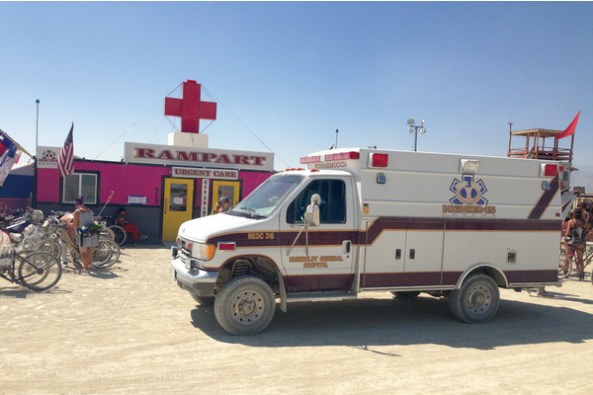
burning-man-ambulance_11219452

Say good night to the ambulance. That’s the last time you’re ever gonna see a ambulance like this again.

Humboldt General Hospital was recently dumped by BMOrg as the provider of medical care on the Playa. A shame, since they have a hospital and ambulances nearby, and from what Burners are saying they have done an excellent job for the past 4 years.

Now we know a little more about what drove this change, thanks to HGH director Pat Songer. It seems there were several factors:

– Humboldt wanted contingency plans for a Mass Casualty Incident (MCI), and to “shine a spotlight on safety issues”

– Humboldt gave 180 days notice to terminate and re-negotiate the contract, expecting to negotiate in good faith with a partner they’d provided exemplary service to

– BMOrg took that as a “fuck you” and responded with “fuck you too”, ditching HGH for CrowdRX

Other, admittedly more speculative, factors may be the departure of BMOrg’s Emergency Services Chief Jospeh Pred and the new team being assembled around Operations Chief Charlie Dolman; and the rumor media report of a West Nile virus outbreak in Gerlach last year.

Presumably CrowdRX already have these Mass Casualty Incident contingency plans in place, given that they do much bigger events like Coachella. Of course, the main issue is “take a lot of people to the nearest hospital”, and there are plenty of buses in Palm Springs. The danger here to Burners is that –  by their own admission – the only experience CrowdRX have ever had in dealing with remote locations was a Phish concert in New England 20 years ago. Pretty sure Phish tickets don’t make you take responsibility for serious injury or even death on the way in…

CrowdRX recently had a disastrous show on their hands in Chicago. They needed a lot of ambulances to transfer 16 people to hospital, out of a crowd of 10,000 ravers at a Skrillex concert. They provided services for Electric Zoo in New York, where 2 people died of “an overdose of MDMA and hypothermia”.

This situation reminds me a bit of the Google employee who is creating Burning Man – The Musical, despite never having actually been to Burning Man. Here we have “Burning Man – the Medical”, brought to you by the team who once hired a guy who went to a Phish concert, but that was twenty years ago. Hey, it’s Coachella in the desert, how hard could it be, right?

From the Journal of Emergency Medical Services:

Humboldt General Hospital began providing medical care at Burning Man in 2011. Each year, Songer said his agency tweaked their contractual relationship with their host to compensate for increased numbers of participants and the associated risks of hosting one of the country’s largest mass gatherings in one of the world’s most remote and austere locations.

This year didn’t seem different except Songer said some safety concerns identified by his staff in 2014 needed clarification, so in February, the agency exercised their 180-day right to cancel their contract.

That happened in a meeting with Burning Man officials and the entire group agreed to move forward, intent on renegotiating a new contract that, among other things, would allow for at least one more EMS agency to provide backup in case festival numbers surged again, like they did in 2012.

“We just wanted to continue that same level of preparedness,” said Songer. “After all, this is a large-scale event with the potential for an MCI in the middle of nowhere. I think some people forget the potential for disaster there.”

Still, the two parties tended to disagree on Humboldt General Hospital’s role: was the agency simply an event contractor or were they a public safety agency with all the associated risks and responsibilities?

Last week, when Burning Man officials announced they were negotiating a contract with CrowdRX, a large-scale event contractor, Songer said he got his answer.

“I think that was really the crux of our concerns,” he said. “When we came to this event, we saw it as an extension of our hospital. We were going to provide hospital-level care, even if it was in the middle of one of the world’s most remote locations.”

He continued, “We weren’t there as an event contractor, we were there as a medical provider in the Black Rock Desert—a fully operational, gold star-staffed medical facility.”

Songer added, “I think as the event evolved and our expectations for safety continued to escalate, philosophically and operationally, we found ourselves on opposite sides of the coin.”

The agency was certainly planning to complete its initial five-year commitment, said Songer, and hoped to see that relationship continue beyond.

Apparently, so did many others, including officials from local, state and federal governments, hospitals and even law enforcement.

“There is safety concern out there,” Songer explained. “When Nevada is investing so much to hold an event of this magnitude here, you want there to be some long-term good that comes from that collaboration.”

“Sure, you can issue that temporary license,” said Songer, “but what we’re hearing is worry about the long-term. When your hospital or your Nevada ambulance company provides those services, there is an investment there, an investment of time, experience, equipment, manpower and you come out more prepared—way more equipped for Nevada—than you went in.”

…With HGH out of the medical mix, and REMSA before that, Nevada’s medical network has definitely lost a one-of-a-kind training ground. That being said, Songer said he is proud of what HGH EMS Rescue brought to the festival’s table during his medical tenure including, according to Burning Man officials during early April, his agency’s ability to “shine a spotlight on safety.” Other successes came with the agency’s partner relations, which Songer said were critical to his agency’s success at the event and in the future through the many mutual aid agreements forged during the festival.

“Burning Man did not define who we are; we defined the systems that made Burning Man’s medical an incredible model across the world,” he said. Now, said Songer, HGH EMS Rescue will take that model and continue to adapt it to the other special events it oversees each year, including the increasingly popular music festival “Night in the Country” as well as the up-and-coming “Further Future” festival, 45 minutes outside of Las Vegas

The full press release from HGH is at the bottom of this article.


robot heart distriktHGH will be providing medical services for Burning Man off-shoot Further Future, happening this weekend. Further Future is put on by the Robot Heart crew, who have thrown many large parties on the West and East coasts.

YourEDM says “Further Future Takes The Festival Experience To The Next Level”:

For many of us, the weeklong desert exodus of Burning Man is simply too much to stomach. From the inevitable lungfuls of dust to the complete isolation, some festival goers would rather have comfortable amenities and leisure than try and test their physical endurance and stamina. Robot Heart, host to some of the most elaborate events held during Burning Man, understands this mentality and has announced the conception of an entirely new experience to go down this May only 45 minutes from Las Vegas.

 
Robot Heart; photo by Peter Ruprecht

Robot Heart; photo by Peter Ruprecht


Further Future aims to be one of the first events to equally combine the aesthetic and vibe of a music festival with the guest list and esteem of a Silicon Valley tech conference. The desert party is only open to invited guests and those whose applications are approved. Among the supposed 3,000 attendees will be Soundcloud founders, Google X directors, and heads of other technology companies currently at the forefront of the movement. These guests will be hosting panels and tech talks amongst the artists performing, fostering an entirely unique and somewhat career-oriented approach to the festival scene. Professional networking is just as much a part of the experience as jamming out to the stacked roster of musicians. Unlike Burning Man, energy conservation is not of chief importance at Further Future, as they will be offering a staggering amount of high-end amenities to those willing to shell out dollars. In addition to the $275 tickets, luxurious pre-built group camping tents complete with A/C are being offered at $3,200 for the weekend. In the “Gypset” members-only area, there will be round-the-clock food and spa services provided.

Screen Shot 2015-04-16 at 1.21.08 PM

And Forbes says Burning Man’s Cool Kids Break Off To Mix Music And Tech At New Festival:

For the past few years, Robot Heart has been known to host the most stylish gatherings during the week-long desert revelry that is Burning Man. Known online as a group of “doers, dreamers, artists and entrepreneurs,” the party-throwing collective could often be found on the desolate expanses of Black Rock City dancing until sunrise during the week before Labor Day, which sees many a Silicon Valley tech employee take off “to discover, exercise and rely on his or her own resources.

This year, however, Robot Heart is making sure that its followers won’t have to wait until the end of summer to lose themselves in a haze of dust, heat and extracurricular substances. At the beginning of May, the collective will host its first Further Future festival, a three-day get-together in the Nevada desert that’s a 45-minute drive east from Las Vegas.

While there are some similarities to Burning Man, which drew nearly 70,000 people last year, Further Future is deliberately more exclusive, an invite or application-only party that does not preach the same inclusive principles or self-reliance of its effigy-torching predecessor

There was a brief moment of last-minute panic when they couldn’t use the venue they wanted, after the BLM moved to shut them down. Fortunately, a local Indian tribe stepped in to save the day.

the invitation-only festival for as many as 5,000 people will be held May 1-3 on the Moapa River Indian Reservation along Interstate 15, about 40 miles northeast of Las Vegas.

The site won’t look quite like the beautiful landscapes shown on Further Future’s slick website, but it will help avoid federal trespassing charges.

Early this month, both the National Park Service and the Bureau of Land Management denied the festival a commercial use permit for roads crossing public land to the privately owned Anniversary Mine, a 215-acre tract just outside the boundary of Lake Mead National Recreation Area 35 miles east of Las Vegas.

Then, just in case there was any lingering confusion, the BLM’s Las Vegas field manager, Gayle Marrs-Smith, sent a strongly worded letter to the mine’s owner and the festival’s attorney warning against using the site and treating the resulting fines and penalties as another “business cost” for Further Future. [Source: Las Vegas Review Journal]

Mixing music, tech, and networking sounds a lot like SXSW, which BMOrg’s merry band of travelling salesmen “represent” at.

Some Burnier-Than-Thous and Radical Haters would no doubt breathe a big sigh of relief if Robot Heart and other large EDM crews left the event, and took their rich and beautiful patrons with them. “The future is in the Regionals!”, they cry.  “You’re not a Burner if you have A/C!”

It would be naive to think that Burning Man could continue to reach its current 70,000/$34 million capacity purely with poor people (who somehow still manage to drop a couple of grand partying for a week), bike theft, home-made art, and unamplified music. The track record of Burning Man’s Regional Network as event producers is less than impressive. The last Robot Heart party I went to was On The Fucking Moon for Halloween in New York, the year Hurricane Sandy hit. They had no problems selling out what looked to me like a crowd of about 5000. Meanwhile regional events like Kiwi Burn pull less than a thousand people, even after more than 10 years. Maybe the future of Burner culture is more likely to lie in the hands of promoters, than bureaucrats and lawyers?

Despite Larry Harvey’s anti-EDM proclamations, I think the organizers of Burning Man Nevada are well aware that the surge in popularity of EDM and the simultaneous surge in popularity of their festival is no coincidence. Their Board member Chip Conley runs Fest300, which gives them intel on all the other festivals in the world. Size, attendance, popularity, ideas. With all the art cars, major sound camps, and smaller music setups throughout the city, there are more than 1000 music stages at Burning Man. Try finding that anywhere else – and who cares if some of them want to publish their line-ups? They are putting these DJs on for free, as a gift, why wouldn’t we all want to celebrate that?

Image: Snowbrains

Image: Snowbrains

The article I wrote last August What Dreams May Come is starting to look very prescient, now that Further Future has been announced. The poll there said 75% of Burners think there is room for more Burning Man-style events in the world without BMOrg, and only 4% thought they needed to be official Burning Man regionals.

So here we have a break-away EDM festival in the desert, profiled in business publication Forbes, featuring the most popular ever Burning Man art car – and, if you’re been to a Robot Heart party in Black Rock City lately, you will have noticed an armada of dozens of art cars that follow them around too. The “cool kids of Burning Man”, going off to do their own thing: exclusive, curated, professional. And HGH has partnered with them to bring a medical solution that is as good as Burning Man – the gold standard for events in the desert. All of a sudden, Larry & Co mysteriously ditch HGH in order for what looks like an inferior and woefully unprepared alternative. And then, also all of a sudden, the BLM at the last minute decides to fuck the festival organizers over on their permit and threaten them via lawyers.

Coincidence? Or conspiracy Nevada politics?


Humboldt seemed to deal with the local issues just fine. In 2011 they garnered industry praise for saving someone’s life with “miraculous” cardiac treatment.

In 2013 they were featured in an article “EMS In Charge At Burning Man” which began with the headline “If EMS Ran The Show”…possibly this was seen as some sort of challenge to the authority of Larry & Co.

Image: EMS World

Image: EMS World

This article is very informative. This was much more than just a week-long paid gig for HGH:

Burning Man itself may only last a week, but planning for the event is year round, says Louis Mendiola, BS, EMT-II, wellness coordinator for Humboldt General Hospital. He says one of the major challenges that go into that planning relates to recruiting, hiring and credentialing the nearly 400 Burning Man employees who will help oversee care.

“Establishing EMS for Burning Man is no easy task,” Mendiola explains. “The austere environment, remote location (no existing infrastructure) and the large population present a number of challenges. HGH relies heavily on the dedication of members of the Burning Man Leadership Team to ensure the operations rolls out seamlessly. HGH has organized a team of some of the nation’s best EMS leaders from a number of different backgrounds and areas of expertise. HGH strives to continually find ways to improve the operation by creating systems that improve patient care and system wide readiness. The willingness to incorporate EMS leaders from such diverse backgrounds has equated to an operation that is truly ‘high performance.’”

They have done more than just provide some medical staff on-site. They have created a fully functional emergency department, with ultrasound and x-ray machines. Their idea was to treat patients as much as they can on-site, where their medical expenses are paid for by Burning Man’s insurance, before sending them off to a Default world hospital where the patient’s own medical insurance presumably picks up the tab.

Instead of approaching Burning Man like any other mass event, we looked at the geographic distance to civilization and healthcare facilities, the environment, the attendee type, and decided to take a more global direction,” explains Bledsoe. “Instead of just placing ambulances and first aid stations everywhere we decided we would develop an integrated emergency healthcare system that ranged from first aiders to board-certified emergency physicians. We specifically wanted to use paramedics in an expanded role because they are already accustomed to the austere environment, independent thought, and the general mindset of the event medical and EMS leaders. As emergency physicians we saw the capability to safely expand their scope of practice to meet the needs of Burning Man.”

Because the providers on-site at Burning Man are quite literally the only care for miles, patient care needs to be robust and all-encompassing. The care provided ranges from minor to major and during the entire event there is at least one physician level provided and one medical director on call (usually via radio), says Mendiola.

“As with a typical ER, most patients are first seen by a triage nurse or tech, who decides which of the four pods the patient is best suited for,” Mendiola states. The actual structure is comprised of four inflatable disaster-type hospitals and a large wooden triage structure that serves as the entry way. More impervious mod spaces are used for x-ray, a suturing suite and command offices.

“We operate a fully functional emergency department, with facilities for minor care, emergency care and extended care,” adds Bledsoe. “We have x-ray, ultrasound and lab capabilities. While we rely heavily on emergency medicine residents and fellows, a Nevada-licensed medical director is within the hospital or nearby at all times (with a radio). We reduce fractures and dislocations, repair lacerations, manage drug overdoses (including mechanical ventilation), use deep and moderate sedation, and treat multiple common medical conditions. On the last Saturday of the event, the day they burn the man, we become one of the busiest, if not the busiest, emergency department in the United States. We will exceed the volume of patients we see daily at UMC in Las Vegas (a big, busy public hospital) by over 40% (more than 600 patients on the last Saturday). We have a large formulary/pharmacy of prescription and non-prescription drugs to treat the attendees at the event. And all medical care is provided without costs to the attendees, keeping with the prevailing spirit of the Burning Man event.

Notes Mendiola, eight ALS ambulances are staffed and deployed with at least one ALS level provider. One EMS operations chief oversees ambulance observation and one incident commander is available 24/7. An airway team/critical intervention team is also available to assist with advanced procedures.

The patients the EMS providers and medical staff see during Burning Man are quite diverse, encompassing all ages (though relatively few are children) and all walks of society.

“The population is generally healthy and chronic conditions are less common,” Mendiola says. “Unlike a regular healthcare system there are typically fewer patients with secondary gain issues, like drug seeking, doc shopping, or who are indigent.”

But the perception of risk is highly distorted on playa (the desert). “The culture equates to risky behavior, which subsequently means more injuries,” explains Mendiola.

“We see a lot of lacerations and fractures, eye problems, skin problems, female urinary tract infections, dehydration and similar conditions,” says Bledsoe. “Although many people think Burning Man is a drug fest that’s far from the truth. In 2011, only 2.5% of the patients we saw were drug or alcohol-related. The Burning Man systems actually take care of most substance abuse problems in a separate facility, referred to as the sanctuary. We help them with medical issues, if present, and have sent some of our psychiatry residents over to the sanctuary to help.

“We treat all comers,” Bledsoe continues. “Sometimes all they want is a medical opinion, a band-aid or an over-the-counter medication. All patients who present are assessed and triaged to the appropriate level of provider (e.g., EMT, community paramedic, nurse, physician). There are certain things we don’t get into unless absolutely necessary. We don’t do sexual assault exams and female pelvic exams. We did treat some pregnancy-related issues but had ultrasound available. High-risk issues and problems are immediately handled by the most senior personnel. For example, we had a patient go into labor at 36 weeks. I personally assumed her care, did a quick OB ultrasound, checked her cervix to ensure she could safely make the trip to Reno, contacted her OB/GYN and the labor and delivery department in Reno, and safely sent her to the hospital by ground ambulance.

“The difference between Burning Man and other big events,” adds Bledsoe, “is that we can’t simply say, ‘That’s all we can do here. We’re going to send you to the hospital.’ The closest hospitals are 150 miles away and sending an ambulance to the hospital can take 6–7 hours to go and return as the event enters the weekend. We try and do as much as we can on site. If a patent needs more detailed care, imaging (e.g., CT, MRI), or hospital admission we send them to Reno or Sacramento. Some can go by private vehicle. We pride ourselves on minimizing transports off the desert. People plan for this event all year, spend a great deal of money to attend, and want to stay through the final ‘burn.’ The people are quite nice and thankful. Pat (Songer) always receives nice letters from patients who compliment the medical care at Burning Man and even go on to say that they feel that medical care at Burning Man is a model for healthcare in general.”

Here is the full press release from HGH (emphasis ours):


FOR IMMEDIATE RELEASE

Contact: Nicole Maher, Director
Community Education and Development
Humboldt General Hospital
(775) 761-2624
Email: nicole@hghospital.org

HGH EMS RESCUE SAYS BURNING MAN ‘LESSONS’ WILL BE INVALUABLE MOVING FORWARD

WINNEMUCCA, Nev.—“We wouldn’t trade our experience with Burning Man for anything.”

That was HGH EMS Rescue Chief Pat Songer’s statement last week after his agency was notified that their four-year contract providing medical care at the annual counter-culture festival has been terminated.

Songer said it’s those “lessons learned” that will stay with the agency long after memories of the dust, dehydration—and even death—fade away.

The art festival in Nevada’s Black Rock Desert gathers 70,000 people each Labor Day weekend, making the make-shift city Nevada’s fourth largest for one week.
“It was a challenge providing medical to over 450 community members each day,” said Songer, “but it was an exhilarating challenge and one that we are immensely grateful for.”

Humboldt General Hospital began providing medical care at Burning Man in 2011. Each year, Songer said his agency tweaked their contractual relationship with their host to compensate for increased numbers of participants and the associated risks of hosting one of the country’s largest mass gatherings in one of the world’s most remote and austere locations.

This year didn’t seem different except Songer said some safety concerns identified by his staff in 2014 needed clarification, so in February, the agency exercised their 180-day right to cancel their contract.

That happened in a meeting with Burning Man officials and the entire group agreed to move forward, intent on renegotiating a new contract that, among other things, would allow for at least one more EMS agency to provide backup in case festival numbers surged again, like they did in 2012. “We just wanted to continue that same level of preparedness,” said Songer. “After all, this is a large-scale event with the potential for an MCI in the middle of nowhere. I think some people forget the potential for disaster there.”

Still, the two parties tended to disagree on Humboldt General Hospital’s role: was the agency simply an event contractor or were they a public safety agency with all the associated risks and responsibilities?

Last week, when Burning Man officials announced they were negotiating a contract with CrowdRX, a large-scale event contractor, Songer said he got his answer.
“I think that was really the crux of our concerns,” he said. “When we came to this event, we saw it as an extension of our hospital. We were going to provide hospital-level care, even if it was in the middle of one of the world’s most remote locations.”

He continued, “We weren’t there as an event contractor, we were there as a medical provider in the Black Rock Desert—a fully operational, gold star-staffed medical facility.” Songer added, “I think as the event evolved and our expectations for safety continued to escalate, philosophically and operationally, we found ourselves on opposite sides of the coin.”

The agency was certainly planning to complete its initial five-year commitment, said Songer, and hoped to see that relationship continue beyond. Apparently, so did many others, including officials from local, state and federal governments, hospitals and even law enforcement. “There is safety concern out there,” Songer explained. “When Nevada is investing so much to hold an event of this magnitude here, you want there to be some long-term good that comes from that collaboration.” In other words, explained Songer, “you don’t want an out-of-state event contractor to simply take the money and run.”

Songer said that concern focuses on the differences between a Nevada medical provider that becomes a long-term asset to the state as it grows its present and future medical network, versus an out-of-state contractor that operates on a temporary medical license for seven days and then leaves. “Sure, you can issue that temporary license,” said Songer, “but what we’re hearing is worry about the long-term. When your hospital or your Nevada ambulance company provides those services, there is an investment there, an investment of time, experience, equipment, manpower and you come out more prepared—way more equipped for Nevada—than you went in.” When you bring in a temporary contractor, that goes away. You’re not empowering a medical network across the state, you’re simply funding an out-of-state business.” “I think that’s the worry,” Songer added.

With HGH out of the medical mix, and REMSA before that, Nevada’s medical network has definitely lost a one-of-a-kind training ground. That being said, Songer said he is proud of what HGH EMS Rescue brought to the festival’s table during his medical tenure including, according to Burning Man officials during early April, his agency’s ability to “shine a spotlight on safety.”

Other successes came with the agency’s partner relations, which Songer said were critical to his agency’s success at the event and in the future through the many mutual aid agreements forged during the festival. Songer also expressed gratitude for the opportunity to learn the complexities of mass casualty incidents—not only the ins and outs of staging such a massive medical operation, but also in learning to “trust other agencies that you only know for one week each year.” He praised the “once-in-a-lifetime chance” to assemble and work with a world-class medical team. “These weren’t contractors who go from event to event, these were medical practitioners at the top of their respective fields; they were there to practice medicine.”

Perhaps the agency’s greatest accomplishment on the Black Rock, however, was creating and adapting a system to the needs of the patients—fully in line with Humboldt General Hospital’s mission of “being helpful and caring for those in need.”
“These people wanted to stay on the playa,” he said of each year’s Burners. “They had invested a lot in terms of their time and money to get there and our job was to keep them there.” Songer added, “It’s no different than what we do at our community hospital. We have invested millions and millions of dollars to allow people to get their care right here at home. “When we went to the Black Rock, that model did not change, so we had to create a system that would allow patients to get the majority of their care “at home” on the playa.

Songer said there are those who will see the severed contract as a black mark for the rural EMS agency. “We don’t,” he said. “Burning Man did not define who we are; we defined the systems that made Burning Man’s medical an incredible model across the world,” he said.

Now, said Songer, HGH EMS Rescue will take that model and continue to adapt it to the other special events it oversees each year, including the increasingly popular music festival “Night in the Country” as well as the up-and-coming “Further Future” festival, 45 minutes outside of Las Vegas.

Of course, the model remains the core of HGH EMS Rescue’s delivery of pre-hospital care across 10,000 square miles, parts of two states and three counties.
“We had an excellent run with Burning Man,” said Songer, “and now all those resources, that knowledge and those experiences come home to our community.”