Art Budget Shenanigans [Update]

A Burning Man artist has responded to my request for feedback in yesterday’s post Follow the Money, with a most interesting tale.


From Anonymous Burner:

BMHQ Artists meeting, 2014

BMHQ Artists meeting, May 2015


This picture was taken at the Follow Up Artists’ Summit held last May at BMHQ.  This was the second meeting after the first one in 2014 where a group of artists tried to make changes in the artist contract for the event but were met with a meeting facilitator that broke everyone up to bitch in different sessions.
 .
Then last May they held the follow up meeting.  Whereas there were upwards of 50 at the first meeting, this one was poorly attended.  Besides myself there was 2 other “Playa” artists and a bunch of newbies.  No one would show up because they knew nothing was going to come out of this meeting. They had tons of food…
.
Looking at the pie chart, they state that for 2015 they would spend $3M on the art.  For ease of discussion, look at 40% Grants, 40% Services, and 20% Administration.
,
1.2M for Grants (now includes Man and Man Base)
$600k on Admin?  Pick a number of FTEs for BRC art at $100k each.  They don’t have 6 FTEs working on BRC art and they sure as hell aren’t paying them $100k
$1.2M on Services?  For the heavy equipment thats used to build the site and is already out there?
.
They won’t feed the artists at the Commissary.  The art projects have to pay for water, fuel, light towers, wood, DG for burns, Etc, Etc.  Plus pay for Port-o-Lets, feeding their crew, and everything else.  How are these service and Admin amounts calculated?
.
Here’s the problem these folks have:
.
They can’t raise money for the BM Project because if you donate to it, what is your donation doing?  I see lots of folks flying around the world talking.  What specific programs can they point to to make a case for donating money to the BM project?
.
That leaves them trying to run the non-profit on the back of the event.  Yes the event makes money, finally – they ran the outfit out of a cigar box for years –  but leaves them unable to increase funding for the artists.  And given the way these lemmings throng to get a spot on the cliff, why should they even consider it.
.
And now that they have to raise money for the BM project, where do they go?  To the folks that have been funding these pieces and supporting the artists.  It is a very shallow donor pool.  The result is “donor fatigue”  these folks are weary of being badgered by the Org and look for more permanent art installations.
.
At the same time, they have to be careful in getting the community to support the artists more – Larry’s latest efforts are lame in that he keeps referring to the moneyed class and most folks say “he can’t be talking about me, I don’t have any money”.  My wealthy friends that have supported art projects in the past have been insulted by his “let the rich folks pay for it”.  Many are taking the year off this year, as am I.
.
Well, I found that somewhat cathartic.  Thanks for hearing me out.


burnersxxx:

Thanks very much for sharing that. The artist raises some good points.

Specifically, from a $3 million budget, the numbers work out to:

$1,290,000 Art (43%)

$570,000 Admin (19%)

$1,140,000 Services (38%)

Heavy Equipment Rental was $2.45 million in 2014.

From a $1.2 million Black Rock City art budget, in 2016 they are paying for:

60 Honoraria art projects. Partial grants, artists have to raise most of the project costs themselves

33 Guild Workshops. Regional projects. Projects required to raise almost all the funding and supply personnel themselves.

The Man

The Piazza

The “Turning Man” contraption

The Temple. Partial grant, artists who “win” the project have to raise most of the funding themselves

4 Belltowers

A blacksmith shop

Possible other sculptures

Is the $90,000 what gets spent on art across Burners Without Borders, Black Rock Arts Foundation, Burning Man Arts, and all the other non-Playa activities?


[Update 3/15/16 5:44pm]

The artist has responded to some of the questions raised in our comments. emphasis ours

A question was raised about tickets and that was a good point.  I don;t know how the value of the tickets given to artists/art projects is calculated or categorized.  Here is what I do know – 
.
Registered art pieces (funded and non-funded) get access to free tickets, vehicle passes, early arrival passes and the coveted 12 mile (aka Point 1) access privilege
 .
In addition to the free art project tickets, there are also half price (aka staff tickets) that are made available to the project depending on project scope, schedule, and staffing.  And if that isn’t enough, the Org can also press the special button and grant full price tickets to the artists as well.
.
When the Org gives an artist a free ticket (or a half price ticket) how is it categorized in the accounting?  I would bet that in the calculations for the BRC art budget that the tickets are added to Administration or the Services figure at face value ($390).
.
One way artists can take advantage of the Org is to have a high profile project start to go bad.  When that happens the tickets and vehicle passes can really start to flow.  A case in point is last year’s Temple – they had like 150 people in their build camp – due to physical constraints they really couldn’t have more than about 30 people working on the Temple at a time.  Even allowing for a generous support crew there was still upwards of 50-75 burners early to the event getting the party started early.
.
The other question that was raised had to do with the construction of the Man Base and The Man.  One of the reasons the contractors category has been growing is that the “traditional” Man Base and Man Build crews have been terminated.  The Man and the Man Base are now basically built by hired carpenters – the Org has outsourced the construction function under the guise that “professionals” were needed to build the infrastructure for the city.  They got rid of the Man Base crew in 2013 (Cargo Cult) and the Man Build crew in 2014 or 2015 depending on how you define the termination.
.
Another change for contractors happened this year when the Org eliminated the DPW Power Crew and outsourced the electrical grids to Agreko.  They kept a small crew of former DPW Power folks in supervisory roles, and the end result is a little more Disneyfication of the event.  Eventually they’ll outsource gate and perimeter to a security firm and the event will have all the charm of a visit to Ikea.
.
The shark was jumped in 2012 with the ticket lottery.  When we look back 10-15 years from now I believe we will acknowledge that the year tickets became scarce was the year the Org stopped caring.
.
This is an interesting point about the accounting. If a $397 ticket is sold for half price, do they write it off in the books as $200 of “Admin Costs” (claiming full revenue for the ticket, then the lost revenue as an expense) and then claim that they are contributing this towards arts?
 .
Why is the only time this “$3 million on art” figure appears in a small, quiet meeting with artists – and all the press discussion is of $1.2 million or $1.5 million? Why do they feed artists generously  (and unnecessarily) at HQ, yet shut them out of the Commissary during their builds?
.
Thanks very much to the artist who has been contributing here, I can confirm that I have also heard what they are saying about entire crews being sacked and replaced with contractors from other sources. People who have given a decade or more of their lives to physically constructing Burning Man have been shunted out the door, while newcomers get to cash in. One consequence of this corporatization/Disneyfication is that it is more scaleable and movable. As I said recently to VICE, let’s take this show on the road!

Follow the Money [Updates]

If you thought this year’s theme of “Da Vinci’s Workshop” and the corresponding shift of Propaganda Minister Will Chase over to the Maker Movement meant that 2016 was going to be all about 3d printing, laser cutting, computer-controlled manufacturing, nanomaterials, and all of the exciting things going on in Silicon Valley with the built environment…think again.

So far, it seems, it’s all about money.

We’re not quite 10 weeks into the year, and already we’ve had:

Art, Money and the Renaissance: Re-imagining the Relationship

What Powered the Renaissance? (Could it Have Happened Without Cash?)

The Renaissance’s $ecret Weapon for Arts Funding

How Burners are Re-Inventing the Artists Workshop (answer: “fronted by a master and funded by a relatively small group of wealthy clients”)

And now, Larry Harvey’s latest post “Following the Money: the Florentine Renaissance and Black Rock City”

Is it just me, or is there a bit of a “theme within a theme” starting to emerge here?

In the new post, Larry likens BMOrg spending $1.2 million in art grants to Lorenzo de Medici taking notice of the young man Michelangelo and moving him into his palace to get intimate, or Peggy Guggenheim sponsoring Jackson Pollack.

When Lorenzo de’ Medici adopted the young Michelangelo into his family, he did much more than hire on a hand to serve his needs. Private patronage is personal; it is immediate and intimate, and what is true of Florence and our temporary city is also true of every celebrated art scene ever known. One example is the relationship of a famous heiress, Peggy Guggenheim, and Jackson Pollack, a struggling painter. Peggy paid the painter’s daily bills, bought his work when no one else would, and organized his first art show. At a soirée held in her home, she even let him pee in her fireplace (though not on the carpet)…

…Money sluiced through the streets and piazzas of Renaissance Florence, and yet the sheer hydraulic force of capital did not determine every outcome. Money was a means, but not an end. What mattered most was social interaction in the context of a networked culture driven by ideals, and Burning Man may be regarded in a similar light. One way to fathom this phenomenon is to follow the money. In 2016, Black Rock City will distribute 1.2 million dollars to artists in the form of honoraria.

It is around 3% of revenues – almost exactly half this year’s $2,349,000 Vehicle Pass take.

Artists have been asking for a fair and equitable contract. Here at Burners.Me, we have been suggesting more should be spent on art than on lawyers. It doesn’t sound like Larry & Co are listening to either of these groups, so we wonder where the feedback he’s getting is coming from – and if his information diet is being distorted and propagandized as it moves up the food chain.

In the case of Burning Man, such quasi-governmental patronage does not exhaust resources that are devoted to art. As with competitions sponsored by the Wool Guild, Black Rock City’s honoraria are awarded by a small committee, but this curatorship, as practiced by a few, is counter-balanced by a radically populist patronage. Each year many artist groups will subsidize their projects through community fundraising events and crowd-sourced campaigns on the Internet. Some critics say that Burning Man should shoulder all of these expenses, but we have found that self-initiated efforts create constituencies, loyal networks that support these artists on and off the playa.

This has produced a flow of art that’s issued out of Black Rock City in the form of privately commissioned work, civic installations, and exhibitions subsidized by festivals. Now this surge of money in support of art is going global.

[Source: Burningman Journal]

Radically populist patronage? Sounds like Sanders and Trump voters.

I would love to see a link to somewhere on the Internet where somebody said that BMOrg should pay all the costs of all the art at Burning Man. I think the general consensus here has been that they should pay more of the costs than a third of the pieces they promote the crap out of and claim credit for – and they should probably pay for The Temple, the same way they do for The Man.  Let us spend our artist funding budget supporting pieces that wouldn’t otherwise get there, rather than mega-works you can promote with Oprah and Dr Phil and sell tickets to for $1207+ for spectators to come and behold.

Here is a recent link to Larry Harvey repeating his oft-told tall tale that “no artist has ever signed their art at Burning Man”. This previously espoused philosophy seems to be the antithesis of his latest claim, that the art at Black Rock City funded by their annual Medici donation of $1.2 million (by year BM30) has enabled outside careers and markets for its artists. Personally, I believe the latter to be closer to the truth, and his earlier claim to be false. Nice to see you coming round, Larry.

Last year, in an interview with Ignite Channel, BMOrg were claiming to have created their own art market.

So instead of trying to cater to the traditional art market, Burning Man has created its own. The Burning Man Project not only funds art projects shown at the festival itself, but supports artists creating interactive projects in cities internationally. 

Many cultural festivals have since followed Burning Man’s example in putting art front and center. With pride, Harvey shares: “Many people come [to Burning Man] for the art and stay for the community. (…) We are making it more possible for artists to sell their art in such a way that they can live off their art.” By supporting artists who would otherwise struggle to gain recognition in the traditional art market, Burning Man and other festivals are giving birth to creative dreams while shining a light on unlikely art.

“Anybody who’s going to take art as a vocation has to endure enough. Artists deserve to make a living.” — Larry Harvey

https://vimeo.com/124528604

I would be interested to hear the opinions of some Burner artists about this. Has BMOrg helped them to live off their art? Last we heard, BMOrg’s artist contract specifically forbade artists from paying themselves anything from the art grant. It also said BMOrg take a 10% cut if the art piece is sold off-Playa.

Are they going to claim credit, and a cut of the money, for this? If you ask me, the credit and the money should all go to Marco.

Bliss-Dance-Marco-Cochrane-web_t1000

Artist Marco Cochrane with Bliss Dance, now in front of the MGM at Park Las Vegas. Image: MGM Resorts

[Update 3/13/16 11:55pm]

A reader has let us know that the reason the art grants have “increased” from $850k to $1.2m in the last couple of years is that the costs of The Man are now being lumped together with Art Honoraria grants.


[Update 3/13/16 5:42pm]

Here’s what BMOrg said last week:

Burning Man Arts is funding BRC art to the tune of $1.2 million this year, including these Honoraria recipients, as well as the sculptures, the bell towers, and the 33 Guild Workshops in the Piazza around the Man.

The sculptures? Meaning, The Man and his rotating clock frame? Or other sculptures as well as the Man and the Temple?

The $ are also funding blacksmithing collective Iron Monkeys, linked to BMOrg Board member Kay Morrison, to provide a functioning blacksmith shop in the desert:

There will even be a functioning, participatory blacksmith shop — the Piazza de Ferro — built by the Iron Monkeys. Sparks will fly!

What further indications do we have that the $1.2 million BRC art budget is funding The Man, as well as everything else listed and fractional funding of 60 art projects?

In the most recent financial information we have for the Burning Man Project (2014) the Man and platform can be found at the bottom: $407,055 for Cargo Cult and $237,581 for Fertility 2.0. It’s hard to imagine that 2014’s 120 foot-high Man cost much less than this to construct.

As you can see, in 2014 the Man and Platform are no longer being listed as a separate line item (Donations to Schools and Regionals have also disappeared). Are they office expenses? Contractors has risen $2 million from 2013 to 2014, neatly mirroring a drop in (estimated) profit after all expenses from $4 million to $2 million. Perhaps it could be hidden away in there – but, why?
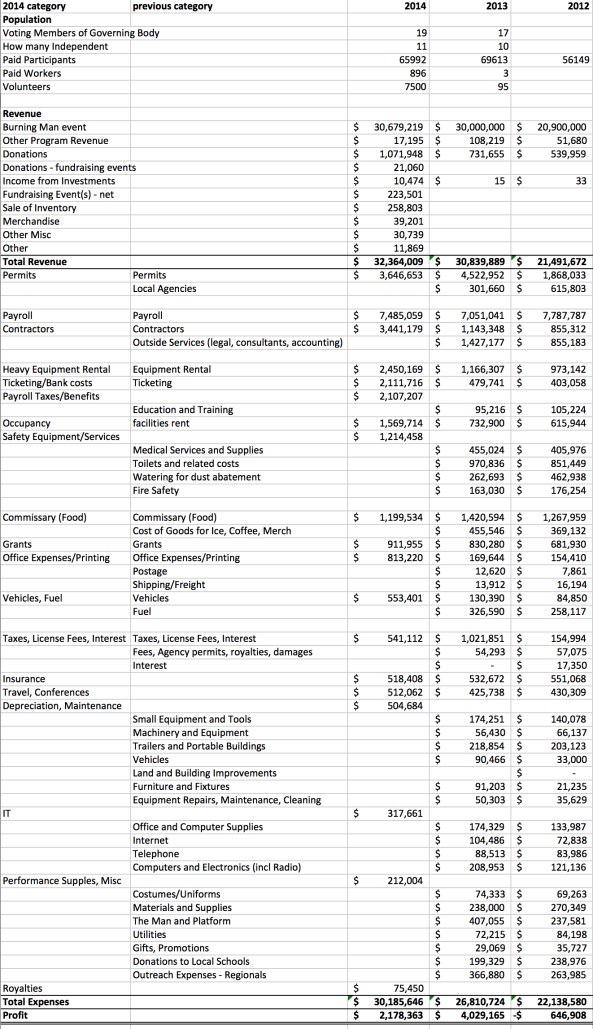
2014 bmp comparison financials 2013 2013 burnersdotme 2

Burning Man Tickets: $1500 [Updates]


Image: Thomas Tomaso, Facebook

Image: Thomas Tomaso, Facebook

The shenanigans have ended. As we predicted, once the dust has settled from all the propaganda histrionics, BMOrg have raised ticket prices yet again. The 9% Live Entertainment Tax will be passed on to Burners – unless a miracle happens and Nevada rules that the “Burning Man tax” was never meant to apply to Burning Man.

We haven’t yet received a response from the Nevada Department of Taxation to our inquiry. We had hoped to resolve this matter before selling tickets so that participants would not have to pay the tax, but the state is taking longer than we expected to issue an opinion. Unfortunately, this means we will have to collect the tax at the time of purchase, as per the law. At 9% a pop, this amounts to an additional $34 for each $390 ticket (if the tax is found not to apply after ticket sales commence, we will issue a refund for the 9% collected)

[Source]

BMOrg have created a new “class” of tickets for 1000 Super-Elite VIP patrons. These VIP tickets are a staggering $1200 each – which is actually $1299  including vehicle pass and handling fees. The 42% of Burners who live in California may have to pay double tax on their tickets – 7.5% sales tax plus the 9% Live Entertainment Tax. This will add almost $200 to the ticket price, for a total of $1497 per ticket.

Vehicle passes have increased in price too: now $80. BMOrg claim the vehicle pass program as a huge success, because it used to be 12.8% of participants arriving in a car by themselves, and now it’s down to 10%. Interesting that they are using this statistic, instead of vehicle numbers. Is the goal to get vehicles off the road, or to stop people arriving by themselves?

They have also hiked the price of 5,000 pre-sale tickets to $1000 each – well, $990, but you get the picture.

Regular tickets remain at $390 (plus taxes, $12 mailing charge and $7 handling fee). Half of the regular tickets (25,000, and 13,000 vehicle passes) go to those selected by BMOrg to be in the World’s Biggest Guest List – the Directed Group Sale

There will be 6000 tickets at $190, for the Low Income program and staff.


[Update 3/13/16 6:46pm]

Now that the sale has happened, we know a $7 “handling fee” is applied to each individual ticket and vehicle pass. Really, each ticket costs $7 more than the listed price. Rather misleading and deceptive conduct, if you ask me. Here is an update revenue calculation, including the Nevada Live Entertainment Tax also.

Screenshot 2016-03-13 18.45.44


Burning Man’s event revenue in 2014 was $30,679,219.

This statement from the Tickets page is a little confusing:

A 9% Nevada Live Entertainment Tax will be added to the price of all tickets and $3 of the $7 per ticket service fee. Will Call delivery is the only method subject to this tax, but the $12 fee will be inclusive so additional tax will not be charged to you for this option.

So if you get the ticket mailed to you, you don’t pay the tax? Or you have to pay an extra $3 if you go to Will Call, which is in Nevada? Are BMOrg saying they are going to cover the $3 extra tax component of a Will Call sale?

Registration for the Pre-Sale opens February 10, and the first sale takes place at noon on Wednesday, February 17.


[Update 2/4/16 7:55am]

I’ve been trying to confirm if the California sales tax applies, and if so is it just the $1200 or the whole transaction (including the Vehicle Pass, $19 processing charges, and Live Entertainment Tax), without any real success either way. Perhaps someone with expertise in this area can confirm whether or not CA sales tax applies to event tickets sold over the Internet via a CA web site to CA customers by CA corp Ticketfly on behalf of NV corporation Black Rock City LLC that licenses the Burning Man name from CA private corporation Decommodification LLC and distributes 100% of its profits to tax-exempt CA parent company The Burning Man Project.

I note that back in 2012, when this ticket lottery system began, the VIP price tier was $390 (and there were no vehicle passes). In 4 short years this has gone to $1200, and the cheapest ticket has gone from $229 (2011, ticket plus handling) to $489 (2016, ticket plus handling plus vehicle pass) – an increase of 113%.

Does this mean that by 2020, VIP tickets will be $10,000 and regular tickets will be $1,000?

In the same time frame the population of the city has grown 25%. BMOrg have added another $7-8 million per year in revenues, as well as being able to save millions on taxes; the city is still the same, portapotties, roads, signs, The Man, Gate, Exodus, Center Camp, First Camp, Media Mecca. Maybe there’s a couple hundred more portapotties, but otherwise it’s hard to see where this extra money has all gone to make the Burning Man event better for the Burners who have to create it.


[Update 2/4/16 12:06pm]

Here’s some data from tracking the secondary market prices on Stubhub in 2015.

Screenshot 2016-02-04 12.06.24


[Update 2/4/16 3:18pm][

Thanks to A Balanced Perspective for picking up on this point.

The revenue from these ticket sales will let us keep prices the same for everyone else. The 1,000 tickets sold at $1,200 each will raise $1.2 million. So what does Burning Man do with $1.2 million? Last year we issued $1.2 million in grants directly to artists through Black Rock City Honoraria. Add to that an additional $1.8 million in support services, and the 2015 BRC art budget topped $3 million. Again, you can learn all about Burning Man’s budget and expenses in our Form 990 and Annual Report.

They have managed to link “$1.2 million in grants directly to artists” to “$1.2 million of Medici patronage tickets being sold”.

It is hard to say if this statement is true or not, since we only just got the 2014 numbers. In 2014 total art grants were $911.955. Did they increase from this to $3 million? We probably won’t know for another year, but I call bullshit.