
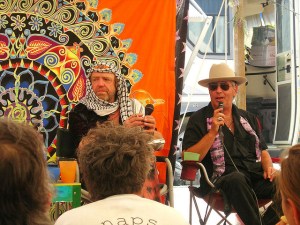
Last year, Burning Man Founder Larry Harvey and “founder” John Perry Barlow teamed up in London for an interview with Tech Crunch. We covered it here: Sauce for Goose and Gander. At the time, they made plans to get together again at Cargo Cult Center Camp for further public discussion. Luckily Burner Nicole from Brooklyn was there to record it and later transcribe it. Perhaps Barlow’s Virgin guest SACEUR General Wesley Clark was also in the audience.
Their subsequent get together, The Founders Speak at Columbia University, hosted by professor David Kittay, was supposed to be published on the Internet “after the first of the year” but is still strangely missing from the public record. Add it to the “Coming soon” list.
It’s an interesting and enlightening discussion, thanks for your efforts transcribing, Nicole – I’ve fixed a couple of typos. Anyone know who the moderator was?
From https://brooklyntheborough.com/2014/02/even-if-temporarily-home-is-where-the-man-burns/
 ‘Tis the season to start planning for Burning Man as registration opens to prance on the desert playa this August. It’s the only beach I’ve ever been to where you have to bring your own water and don’t really need a towel.
Making the trip out west from Brooklyn is definitely a big hassle, but there are plenty of local theme camps to team up with should you decide to go. Or avoid the pilgrimage as many people do and simply enjoy art parties closer to home in the industrial desert of Bushwick.
There are a lot of politics and discussion about whether or not Burning Man is what it once was, or is what it should be. There’s even a current New York Burner email list discussion on the authenticity of “going home” as a term to universally describe one’s trip to Black Rock City, Nevada where it kicks off every year. Everything else is just the default world.
For those reasons and many more, presented below is the transcript of a fascinating hour from Burning Man 2013: a recorded Center Camp conversation between Electronic Frontier Foundation founder John Perry Barlow and Burning Man founder Larry Harvey on the past, present and future of making Black Rock City their home.
————————
John Perry Barlow: I thought I’d ask [Larry] some questions and see how he thought it was going. We did this for a few years and then fell out of practice. Then he and I ran across ourselves in London earlier this year; and found wandering around Westminster that it was a great place to have a peripatetic discourse, and we thought we might want to come back here and re-engage this process and re-engage you and have some thoughts about how we deal with what Burning Man is in its rather mature manifestation. And, uh, how do you think Burning Man is going Larry?
Laughs
 Larry Harvey: I think it’s going wonderfully. This year in particular – the mood here, the spirit here is better than I’ve ever seen it.
Cheers
JPB: Maybe we should start talking about this seemingly paradoxical notion of organized anarchy.
Crowd: Yeah organized anarchy
JPB: Exactly. You know anarchy is a political philosophy – it gets kind of a bad rap by the WTO, but anarchy as a political philosophy was created by social philosophers like [Mikhail] Bakunin and more recently Hakim Bey, and certainly very much by Larry Harvey; and it’s the principle that human beings are basically good and that they want order in their lives and they’re actually quite good at interactively self evolving order around circumstances that may arise collectively, and that they don’t necessarily need some kind of imposed government for them to behave well. We don’t – it’s sort of based on the principle you don’t run over people with your car because it’s against the law, you don’t run over people with your car because it’s the wrong thing to do. And Burning Man from the very beginning was based on the idea that even though there were damn few rules – I mean very few rules – that people would come out here and exercise the golden rule to some extent and not shoot one and other, despite the fact that there was plenty of gun play. And that was actually working pretty well. And I think Larry has done a fantastic job in not imposing all the laws, regulations, codicils, subchapters and everything else that goes along with government. On the other hand, he’s had to have this continuing dance with a very big G form of government. I had an experience the other night upon arrival I arrived at 12:30 at night – on Friday morning, 12:30 Friday morning and I had my ticket and I was told I had to go over to a zone over here some place and wait, wait for what?
LH: You’re referring to D Lot, rhymes with Doom.
 JPB: Purgatory! I said, ‘wait for what?’ They said, ‘wait for the others to come out.’ Which sounded almost biblical. What others? It turned out that BLM – that the permit was for 68,000 and it was not for 68,005 it was not for 68,010. And so not many people leave Burning Man at one on a Friday morning – that’s not when you get one of those major rushes for the gate. So you can sit there for eight hours as I did, waiting for enough people to come out so I could go in, and that was, there we were, we were trying to have a conversation about it, and there we were at the very naked interface of anarchy and government. I think there’s probably a back-story on that; I don’t know how much Larry wanted to tell.
LH: There’s always a backstory, and a backstory behind the backstory. But I won’t talk about that except to say, of course we did have a permit for 68,000 and a public agency that BLM is governed by regulations. However I will point out when we first came out here – there’s a lot of talk about the good old days when it was free and now there’s all these rules. In fact Hakim Bey, who wrote TAZ –
JPB: Temporary Autonomous Zone
LH: A little booklet about radical anarchy – I corresponded with him in the early 90s, no before that, early on, and he had one recommendation, which was in line with his doctrine of Poetic Terrorism and real acts of creativity, which we kind of came out of in the bohemian milieu of San Francisco. We very much bear the stamp of that, but ironically he recommended to me well just avoid any TAZs… Little chinks in the armor of the system, you get in and you get out like theViet Cong. After two years – the authorities overlooked us for 2 years because we were so small, and this is so big, we were a mote in the middle of this in some sense, you were lucky if you came out here if you even found us, which was actually part of the point, lot of people didn’t find us and ended up stranded on the verge of the playa, mired in one of the artisanal water sources here and then that risked your life. They might easily have died. We invited them. We were responsible for their welfare. Holy smokes we were the government! And um, and when he wrote me with his advice, we had already filed a permit with the government, and we had a history of cooperating with the government at Baker Beach when we had to abort a burn and the people from the Golden Gate National Recreation area, another federal agency, intervened, and we actually made an agreement to raise the man and not burn it. Chiefly because the official came out and looked at this assembled man on the beach, (unclear) it just ached with craft and everybody gathered around, who were very invested in it, they were yelling, ‘Shame! Shame! We worked so hard!’
He saw it was manifest with, it was saturated with intention and did something that on a level required bravery on behalf of a field officer in such an agency, he said, ‘Well you can raise it but you can’t burn it’ and we shook his hand and he ran away. Then my colleagues, some of them said, ‘No, we, this is our chance, let’s burn it.’ And that was in line with the guerilla sensibility of the day, but I was brought up to believe that my word was very important, it was a moral issue at that point, and also in the back of my mind it was a political issue because if we burn it here, then where do we burn it next, and will our rap sheet follow us? Probably.
JPB: Were you raised in Nebraska by the way?
LH: Well, my mother came from Nebraska and my father from North Dakota, they were people of the plains, for anybody who comes from the Great Plains you know what that culture is like.
JPB: I am from Wyoming.
LH: Exactly, we have that in common. So we took it down and it caused a riot because by that time so many people who had no attachment to it had heard of it in San Francisco over 5, 4 years of burning it at Baker Beach, that half the drunks in town rolled down, following the path of least resistance to the beach, and they were all roaring, ‘Burn the fucker!’ And I thought, ‘I’m – we’re not going to burn it for you – you have nothing invested in it, it doesn’t mean enough to you.’ And that was our first instance of cooperating with the authorities, and that gave license to our eventual intention out here to form a civil society.
JPB: When you moved out here, what was the process, the decision to come to this particular place? And did you, whose permission, if any, did you ask?
LH: No we didn’t ask anybody’s permission.
JPB: It didn’t seem like the sort of thing that was asking anybody’s permission.
LH: We went looking for beaches in California at first and couldn’t find one that would work and some artists had come out and done things in the Black Rock Desert, because it was then and it is now a blank canvas that just summons up visions and we thought well, ok, it’s naked plain, there’s nothing that can catch fire, then let’s take it there! Only in San Francisco – can you imagine saying that to anybody in LA? They’d say, who’s the producer? In New York they’d say, you want us to go out of town? Laughs So we came back here, didn’t ask anybody’s permission, we were innocent, we didn’t really know.
JPB: When did we lose our virginity in that department? When did we – where did we first find ourselves standing with somebody from the Bureau of Land Management and a clipboard?
LH: It was the second or third year, and that was the time when I corresponded with Peter Lamborn Wilson –
JPB: Also Hakim Bey –
LH: And they let us know that we’d be expected to fill out a permit, and we did. It became drawings, I did a wonderful inspired fantasy of a site plan, it looked good, architectural drawing looked great. Appearances count a lot. Of course, over time, as more and more people came, it’s one thing to say, and it’s true, the golden rule can work, but it only works if people can identify with one and other.
JPB: Right.
LH: What we had seen on the beach, is that this group of people who had nothing invested in it, and for which it reflected nothing back, turned into a mob, and also love, a guy tried to light it three times. Someone had thrown gas on this thing we had decided not to burn, and uh, GAS! He tried to light it three times with a BIC lighter and the third time I lost a little patience was just slightly less diplomatic and took his arm to talk to him and he planted his thumbs in my windpipe and my friends had to peel him off of me. It was a riot! I went home that night and dreamt of the Hindenburg, dreamt of the Dukakis campaign, it was a disaster! I was shaken.
LH: So the question is what to do? What we did was we came out here, that required effort from all of you to get here- a commitment to even get to the dam gig.
JPB: Right find that place!
LH: So it was no longer a place of casual resort, that helped create intention and the conditions here required everybody here had to think existentially about survival and work out their relation to something with something larger and more powerful than them, that’s nature. So that conditioned things right there. In tribal peoples can exist without elaborate government – don’t kid yourself, they are governed by custom, in every detail of what they do has evolved somehow.
JPB: When I was first starting EFF and looking at the internet, I said to my partner one day, this is wonderful, this is a working practical anarchy this internet, and he said, well that may be but it’s been my observation inside every working anarchy there’s an old boy network somewhere and they are the keepers of the actual rule base even if they claim not to be.
LH: The original anarchist philosophers held that you don’t need a lot of government but useful conventions help.
JPB: Yeah, ethics.
LH: Yeah, they were not looking at it as an adolescent.
JPB: Customs.
JPB: Anarchy in a completely heterogeneous society won’t work at all.
LH: No, not really, no it won’t.
Rules develop because common sense isn’t a) as common as you like and b) it’s very hard to understand other people’s circumstances and well it may not be apparent why you can’t speed on the playa, but of course, we all know now, we brought it down to 5 mph, because we thought, well, we can cover, the playa will be covered with art, moving art, but it will only work if people don’t.. well learned the hard way. I had to be awakened early one morning in 1996 to learn a car had plowed through a tent and run over someone’s head. That will get your attention. Then, you know, it reminds me you know, the anarchists scattered, the pseudo anarchists scattered because nobody wants responsibility. It was like when I was a kid growing up on a farm in the country and the big recreation was dirt clot fights, in the early days we weren’t far more evolved than dirt clot fights, tow it around on a tarp behind a pick up truck and those good old days, where –
JPB: Very pure form of anarchy.
LH: The implicit rule of that game was that you just heave, go to two sides of a field and heave dirt clots at one and other as kids, and it would break up when a kid would get a dirt clot in the eye and started crying and everybody would go home.
Laughs
JPB: We developed the catapult out of car springs that shut it down pretty early, we had to have arms control talks.
Laughs
LH: We’re not particularly rule bound, everybody knows that you’re free to express yourself, and indeed the idea of a gift, if you read that, I believe in close readings, read the, it does mention in the principles, only you can determine the content, or a collaborating group, can determine the content of a gift. That’s true of any art effort or collaboration too, and but then it suggests that you should respect the rights and liberties of the recipient, but you know if you give a gift, a good gift well given, you meditate a great degree on whether the person will find it acceptable, therefore a gift is not standing outside of someone’s tent with a megaphone. Laughs So self-expression is bound by custom in that way. It’s just a form of organized kindness and consideration and sometimes it’s not apparent to people as we’re so you know, disparately situated, many social worlds, what the consequences of their reaction might be.
JPB: You have to be mindful of the fact that the golden rule is do unto others has you would have them do unto yourself; treat ourselves badly, and expect others to do so as well. So it’s not an infallible principle. You don’t want to treat others as you treat yourself, you often don’t treat yourself as you deserve to be treated.
LH: Just because you slap yourself around doesn’t make it okay to slap somebody else around.
JPB: Who needs enemies when you’ve got yourself?
LH: So, you know, it is true there’s more spontaneous expression and more exercised freedom and freedom of worthlessness is exercised – going on here than in any other community in this country. But it happens because there is an environing social context that bring certain kinds of order into being that allow that spontaneous phenomenon we know as culture to generate itself.
JPB: In the beginning the idea that there would be a daunting webpage with you know, page view after page view of very elaborate pieces of advice that are strongly stated – that was just, that would have been laughable. The reality is that in the beginning everybody was on the same trip.
LH: Well yeah, they were, I’ll tell you something what I learned about anarchism on the hook in the early days. Anarchism works in very small – the anarchist, the rule, do what thou wilt – works in very, very small groups. I was the little groups of anarchy people, and who would camp in their little campfires and then gossip about all of the people around all of the other campfires that weren’t as cool as they were.
JPB: Or important, or as pure in their anarchy –
Cheers
And that didn’t work out – I had an interesting experience early on a very dear friend of mine Ken Miller, who is the man’s man, in charge of raising the man, initially constructing it – he’s a hero in our community, and a very modest man, a gentleman. He was standing by as some friends who were you know, who had guns, were popping off shots, and personally, I heard stories of how some of those bullets tumbled by tents. Then we actually, that led us to get rid of firearms and I’m proud of the fact that you know, that America can’t deal with gun control and we achieved it.
Cheers
JPB: If you want to have a sense of the culture, right? When I first drove onto the playa I had a Smith and Wesson 327 magnum sitting on the passenger seat and the greeter said nice gun!
LH: The greeters had guns!
JPB: Yeah that wouldn’t happen now!
LH: Somebody asked one of the greeters, Joe Benton, ‘Is that gun loaded?’ He said, ‘Of course it’s loaded, if it wasn’t loaded it would just be a stick!’Laughs And that was fine, except one day they were standing next to they were shooting it was Benton himself who pulled out a gun and fired it on impulse downrange so it looked like..
JPB: All the way to Winnemucca!
LH: Except it was that part from (unclear) and he was deaf for two days. Oh, and then I watched, because I like to watch, I like to watch social interactions, I like to see how they play out, what the actions are, what they really are about. Had it been someone outside of the tribe, they would have strung him up. It would have been ugly, in fact the tribal wrath would have descended on him. But since Dan, the mild mannered gentleman, was not part of the gun group, no one said a goddamn thing about it, in fact nobody apologized, I thought, ‘Ohhh ok, that’s how it works, it’s kind of like, oh, gang rule.’ Laughs And the actually was a significant event for me, it started me on the path of dealing with guns, because what was needed was a higher view of social welfare, that had some sense, that it was super ordinant in some sense that it represented our ideals and concern for the welfare of others in a complicated society, that’s how the west gets won in that regard.
JPB: That’s probably a nice segue into the ten principles. Personally, I confess that anytime that anyone starts stating principles with a capital P, and even has a number for them I usually look for the nearest exits.
LH: Yeah!
JPB: It’s like the twelve warning signs of monotheism. But I think it’s worth having these things written down as general guidelines, as long as we’re very careful in our willingness to say this is not dogma you will not be excommunicated, the church has no authority to remove your insignia.
LH: They’re descriptive not prescriptive. When I wrote them in 2004 I was called and told to write them because people were going out into the world and they were trying to do things and they had been enormously moved by the persuading example of our city even in the scale it had grown to. But back in our daily lives, without that context, whether it’s ceremonial, emotional, moral, or to some degree institutional, it was hard for them to even talk about what they experienced and, so, the call went out so I wrote them. If you notice, if you happen to read them, the imperative voice is notably lacking. It doesn’t say, ‘leave no trace,’ it says, ‘leaving no trace.’ It may seem subtle but it’s different
JPB: There is a refreshing lack of the use of the dictatorial ‘we.’
LH: They described what but that time in 2004 had spontaneously evolved within our culture, our society and in the culture that had fomented, when I wrote them, in an afterthought, I asked were all these present at the beach? Because that’s a good test, where they there at the radical origin? And, by god they were! I was delighted, and including civic responsibility because we cleaned up. We also, because we did the deal with the authorities –
JPB: And kept your word –
LH: We kept our word.
JPB: But now we have the deal with the authorities having become extremely complex with real world politics – what I encountered out there at the gate really was, allegorically was one of the most clearly defined battlegrounds where lines had been drawn between the forces of monotheism and the forces of pantheism, pantheism is, pantheism is operation by the letter – I mean, monotheism is operation by the letter, and pantheism is operation by the spirit, you know, I had been thinking about this quite a lot before I got there because I had been at the White House a few days before and they were struggling with spirit versus letter to a degree that was terrifying as an American. But we are engaged in a very important social experiment here about how to create a relationship with the people of the letter –
LH: Well it is and they have to turn everything into the imperative.
JPB: Yeah, they got the book.
LH: It’s an ongoing dialogue, I came out here, it’s been a crash course out here creating this city all these years. We came out for our otherworldly melody to this other world, and it almost as soon as we got here it’s been a crash course in worldly things: politics, endless politics, If you don’t like politics, cultivate your garden behind a wall! And economics, this actually is a business that takes an income, people say that’s wrong it should be free.
JPB: I can assure you he is not getting rich off of this. But um, but that’s just a continuous thing, in some ways we the government are at opposite ends in terms of moral sensibility and political outlook but we do have one thing in common and that is a genuine concern for public welfare.
LH: Like a lot of relationships, we rub along.
JPB: The problem for Burning Man is it becomes a test case for that early large number of Americans who are still engaged in fighting a war between the 50s and the 60s, I would have thought that 50 years in we would have reached at least as much peace as there was in North Korea, but no, we’re still fighting that war and it’s worse than even and you know, it makes it feel incumbent upon them to come out here and take advantage of the fact they have the absolutely greatest possible case of probable cause ever manifested, I mean, what is probable cause that you are breaking a drug law at Burning Man? You bought a ticket! Laughs Its like shooting fish in a barrel.
LH: But they don’t assert that, of course, they have attorneys.
JPB: I think we should start the Q&A.
LH: Yeah we came here to hear your –
JPB: We feel a vague sense of this being some kind of turning point in how Burning Man needs to go forward and we’re eager to hear your thoughts on the subject.
Moderator: If anyone has any questions please come up and give them to me and I will ask the speakers. I have a couple that I’ve written down listening to your amazing talk – one, what happened to the man that did not burn? What did you do with that?
LH: Oh ok, that’s an interesting story. We took the man who did not burn, stored him in a lot in district in San Francisco that was owned by one of the carpenters, it started with carpenters, carpenters, (unclear) carpenters who did art in their spare time and were in the building trades. And so he was a developer on a small scale and he had this lot, so we just took it in there and we attached it to a cyclone fence at the back and left it there thinking it would go unmolested and then went on with our plans and we were prepared to come to the desert and everything was organized and two weeks before somebody drove by the lot and the guys unbeknownst to him, our friend’s partner had rented it out for parking for the clubs, so they came in with chainsaws and turned the man into curbing. It was gone! No! So we had two weeks to reinvent the construction process that had previously taken a month and a half or two months. And necessity was a good teacher, and we did, we cranked it out and had it down, the famous story of crossing the line, the Cacophonists came out and crossed the line – well I wasn’t there for that, I was back organizing the building, and we had it ready one hour before the truck was due to arrive so we could put it in a truck and take it out here and burn it. I borrowed the money from the guy who owned the lot and paid him back by passing a hat out here, that’s the story of that, so there’s been more than one man, so there’s two extra men, the one from the event out here where it was burned
JPB: A real burner.
LH: I wish after that happened I took it well but inside it was my baby and it got burned so I felt bad and they said the burned man will burn on schedule, but it was too late, they should have said the man will burn at the appointed time, it’s not about you know –
JPB: Radical freedom –
LH: But there have been two men added on to the 27 that have been created, so it’s actually 29 of which, but every family has couple people who have lost their way –
JPB: Certainly in the country they do.
Moderator: You mentioned Hakim Bey quite a bit, I’ve been coming out here since you know mid to late 90s and Temporary Autonomous Zone was damn near a bible for most people out here you couldn’t walk around without someone having it in their pocket. Have you been in any further correspondence recently about the event and what do you think he would think about it?
JPB: Peter Lamborn Wilson.
LH: I have no idea.
JPB: I have a faint idea – I meant to mention this to you, he’s actually interested in us getting together.
LH: Oh really? Oh I’d love that.
JPB: Yeah, I think that’d be a good idea. He lives in upstate New York now. Peter Lamborn Wilson for those who don’t know, was a very serious scholar in comparative religion and wrote a truly remarkable book on all the angels of all the different cultures how various different religions manifested their notion of angels before he got into this idea of practical economy, anarchy, and he wrote his anarchic literature as Hakim Bey and I was spending a lot of time with him in the (unclear, microphone fail) flat on Avenue C and 4th Street –
LH: (unclear, microphone fail)
JPB: Many, many stories up from the street, filled with books, and he actually I think laid these things out very, very well and it bears reading today and I think it actually would be interesting to get him to come out here, he’s kind of old and set in his ways, but it’d be great to get him out.
Moderator: Larry is it true that you were given a ticket for pissing on the playa?
LH: It is not true.
Crowd: Did you piss on the playa?
Moderator: This is an interesting one that I think a lot of people are asking: why do you think the feds, police are here in such force? A) because of the lawsuit or B) because we haven’t been able to deal with other city issues fighting or theft?
LH: No none of that, listen they’ve been out here in force for quite a while in case no one has noticed
JPB: Yeah
LH: And they have more officers out here but it’s not a giant leap.
Crowd: They love Burning Man!
JPB: It’s their Burning Man too!
LH: Practically, I believe in actions and practical analysis. What happens when they’re here early and they’ve got nothing better to do than go out and patrol the roads coming in and stop people for license plates, lights and so on, and then once people are here they lose all interest in that and it’s over –
JPB: What you have to understand about any aspect of the federal government or probably any government is the way in which you establish yourself as being a big kahuna is how much budget you got underneath you. And believe me the district field officer at the Winnemucca district field had far less mojo before Burning Man than he has today; and it’s all a matter of hiring on all these additional budgetary items in the form of law enforcement, which we have to have because of course there are drug laws being broken out here, we have to have enforcement commiserate with the degree of the criminality.
LH: It had nothing to do with the lawsuit that had to do with us and Pershing county and that’s on the way to being, uh, it’s already mostly resolved and we’ll think we’ll come up with a ten year agreement and I doubt very much if anybody is going to go to court.
JPB: Larry can probably put a more nuanced view on this, but it’s pretty safe to say that public safety or the welfare of the Burning Man community has had a very modest role in the presence of law enforcement in Black Rock City.
LH: I’ll say this, I wouldn’t go without the police – when you want a cop, you want a cop. (Unclear) Suddenly someone burgles your house, you want a cop –
JPB: They’re saying it would be good to have the cop –
LH: And you feel –
JPB: It’s good to have the cop off, in the cop, ready to go, staged, rather than having them –
LH: Well, sometimes I wish the cops here were like the bobbies in London, now, I was at Trafalgar Square and some anarchists demonstrated they had the Guy Fawkes mask on and they had gone over the barricades to get to the base of the pedestal that would give them a platform and then the bobbies of course were there. We were just talking, they would stand around them, and use their batons to sort of –
JPB: Define the conversational zones –
LH: Cordon them in and start talking to them, it was very British, it was very civil, I looked at them it was this tableau – there was a girl who was just ranting, and someone else who was just tragically crestfallen, and another guy in this Guy Fawkes mask who had a little sporty cane who was standing there. And then I noticed, and the talks just went on and on – it wasn’t like what would play out in America, there wasn’t a gun in sight. I noticed the dapper anarchist, he was talking to a cop who was down there and he’d talk but when he really wanted to communicate he’d lean out further and he’d tip his mask up and then he’d put his mask back on.
Laughs
Moderator: That’s great, ok, I have one more question and we’re gonna wrap this up guys: You said you like to watch social interactions how’s that working out for you?
LH: I grew up in a world that was interesting, heterogeneous, truck farming region, but the Harveys were from the plains and my father was incredibly self reliant – you can thank my father for the self reliance – and eventually fell, and he couldn’t accept help from others and we didn’t neighbor with people, really, so one of my earliest wishes was, couldn’t we just get everybody out in the field and do something you know, really interesting? Laughs And we got everybody out in the field, and we’re interesting.
JPB: Interesting. I grew up in conditions even more austere than Larry’s – I was the only kid in miles on a great big cattle ranch. At one point my mother – I complained to my mother that I was bored and she said anybody who is bored isn’t paying close enough attention. You know, since the thing that was obviously available to pay attention to was the human comedy, that’s what I’ve been interested in every since. I mean I think Larry and I derive – one of the things we have in common is a great appreciation of the human comedy that is now rich and detailed and immensely pleasurable and there’s plenty of that, you can just sit and be still and have a ringside seat.
LH: In a sense, there’s nothing wrong with necessarily be a spectator, you can be a creative spectator.
Crowd: Yeah exactly
JPB: Absolutely.
LH: Think of all the photographers, you know – oh they’re just photographing us – it doesn’t mean you have to be an extrovert you can be an introvert. You can be someone sitting over there scribbling in a journal shyly who is going to represent – who is going to write the book that goes around the world that represents what we really are to people; and of course that’s what we want to do, we’re working now to spread Burning Man around the world and our community is already doing it. I hate that phrase ‘lead from behind,’ but in a sense we do, we see what the culture does and we act innately.
Moderator: Great! That was an amazingly fantastic and excellent talk, let’s give it up for John Perry Barlow everybody! And Larry fucking Harvey everybody! Come on, let’s give it up big for these guys, we wouldn’t be here if it wasn’t for them, none of this would be here if it wasn’t for them! Everybody go and give them blow jobs after this and make them happy all right? I also need to say that I’ve been moderating this speaker series for a couple years now and that was one of the best talks that I’ve ever had on my stage, I am nothing but honored and proud to be a part of this and I just want to thank these two men right here myself thank you so much! You guys enjoy the rest of your time out here. You guys are all fucking beautiful thank you so much for showing up today and you guys enjoy the rest of your day and don’t die!
[Editor’s note: sorry for the unclear bits, it was the playa, I did my best!]
Help others find Burners.Me
 Here is the WIRED magazine article from 1996 that I referred to. It’s written by famed cyber-guru Bruce Sterling. Being on the cover of WIRED back then, in the fledgling days of the commercial Internet, was like being on the cover of TIME or Fortune today. Bigger, maybe.


