Burning Man Hacked!

image from WIRED

The news of hackers exploiting a “back door” in BMOrg’s new ticketing system broke last week on Reddit. We covered it last Wednesday in Ticket Hell. Now, the story has been picked up by a broader media audience, with stories in WIRED, Computer World, Paste Magazine, CBS Local, and SFist.

WIRED:

Burning Man has practically gone mainstream. The once-fringe desert camping festival is now cultural fodder for The Simpsons and Taco Bell commercials. Celebrities and CEOs routinely attend. So it’s no surprise that 40,000 Burning Man tickets sold out in less than an hour last Wednesday when they went on sale.

But software engineers in Silicon Valley hacked into the Burning Man ticketing system powered by Ticketfly to cut to the front of the queue. Who needs luck when you have engineering skills and you’re willing to use ‘em for your advantage?

…Several engineers and web developers on a Burning Man Reddit thread speculated that hackers were able to create this backdoor after discovering a few lines of JavaScript code on the ticketing website that gave preeminent access to tickets three minutes before they officially went on sale at noon on Wednesday.

“They left code in the page that allowed you to generate the waiting room URL ahead of time,” said Michael Vacirca, a software engineer at a large defense corporation. “If you knew how to form the URL based on the code segment then you could get in line before everyone else who clicked right at noon.”

Burning Man admits the error and says those hacked tickets will be put back up for grabs during the scheduled last-minute sale in August.

[Read the full story at WIRED]

It’s interesting to watch the corporate spin machine in action. Rather than any sophisticated hacking being required, simply entering your code directly into TicketFly seems to have worked. According to hundreds of Burner comments on the Interwebz, clicking the emailed link ten minutes after noon pretty consistently got Burners in to buy tickets immediately, whereas clicking the link a few seconds after noon led to many Burners being stuck in the queue for 90 minutes with no success.

To me, these are the real issues here: it was definitely not First Come, First Served, and it was trivially easy to bypass the queue – multiple methods were used, and most did not require the ability to write code or hack into systems. The focus on these “200 hacker tickets” is smoke and mirrors around the obvious explosion in the number of tickets being listed on the secondary market. Even BMOrg are now encouraging Burners to get tickets and vehicle passes “on the open market”. With software to automatically buy as many tickets as you want from TicketFly selling for a mere $750 – about the profit margin for a single ticket right now – it seems that there continue to be some serious issues with BMOrg’s ticketing system.

Who would have thought they could make it even worse than the lottery? As BMOrg proved with their Spark movie, perceived ticket scarcity makes a nice story for the media.

WIRED:

The way this year’s sale operated, however, didn’t help to dissipate the resentment. Those interested in purchasing tickets were placed in an online queue as each sale was processed and given a time estimate as to how long they would be kept waiting before they could purchase tickets. The time estimates kept shifting, going from an 24 minute wait, to 46 minutes, back down to 18 minutes, to then “more than an hour,” which might as well have read, “abandon all hope ye who enter here.” At one point, the line was inexplicably “paused” for several minutes, causing another nerve-wracking moment on social media.

This drastic, back-and-forth change in wait times gave those in line the illusion that somehow hackers were cutting in front of them and bumping them out of scoring tickets. Burning Man’s social media team responded by saying that the wait times fluctuated based on how long it took each buyer to complete the purchase. It surely didn’t qualm any anxiety to have used such an unpredictable factor as a counter, instead of a fixed number (“There are 39,999 people in front of you trying to buy tickets”).

See the comments from ZOrg in Emotional Roller Coaster From Hell about why this theory of wait times fluctuating because of some people taking a long time to complete transactions doesn’t add up.

WIRED:

This is not the first time Silicon Valley has been criticized for tampering with Burning Man’s ideals and processes. Last year’s festival garnered unflattering feedback from Burning Man die-hards after venture capitalists, executives and celebrities descended on the desert with air-conditioned camps, personal assistants and other VIP-perks. In recent years, Larry Page, Sergey Brin, Elon Musk, Jeff Bezos and Mark Zuckerberg have all scored tickets to Burning Man.

It seems like now, Silicon Valley is leveraging more than its money to get in front of the line.

[Read the full story at WIRED]

Way to shift the blame to your customers, BMOrg. “Silicon Valley is using its technical might to cheat the system and get Burning Man tickets”: it sure makes a great angle for a story, compared to “some people typed the code into TicketFly”.

Actually it’s BMOrg’s leadership that has been criticized for tampering with Burning Man’s ideals, not Silicon Valley. No-one gives a flying fuck if Zuck brings his P.A., but many Burners do care when some on the Board of Directors are selling $17,000 hotel rooms like it’s some sort of Mega-AirBnB in the desert, and getting an unlimited supply of tickets for their customers and sherpas.

Cancelling 200 tickets will do nothing to fix the problems that occurred in the Directed Group and Individual ticket sales. There is no evidence that it will hurt scalpers, indeed it may even punish some Burners for being radically self-reliant. BMOrg have said they will void these tickets and add them back to the OMG sale – so now there are 1200 tickets left, for 60,000 Burners to attempt to buy in milliseconds on August 5.

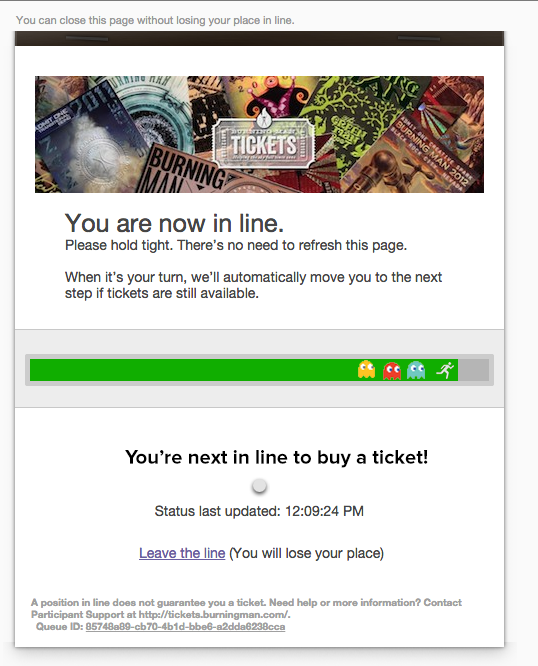
“Emotional Rollercoaster from Hell”

BMOrg’s latest post on ticketing does nothing to quell doubts about the motivations behind Ticket Hell. Taking us on an emotional roller coaster from hell, and generating and focusing a massive amount of psychic energy around a totem, are clearly uppermost in the minds of the rulers of Burning Man:

it takes time to process all those transactions. Maddening time. Anxiety-inducing time. Time people spent on an emotional rollercoaster from hell, as they waited helplessly to see whether or not the winds of fate would blow a golden ticket into their hands. And during this time, probably more intensive psychic energy was heaped onto one single thing than anything else in Burning Man’s 29-year history: The Little Green Man.

The Little Green Man
Green Man walkin’.

The Little Green Man (yes, we’re capitalizing it, shut up) was the little dude standing, strolling or running along the progress indicator bar, marking one’s advancement through the ticket queue. As ticket-seekers urged him on with a fervor worthy of a filly at the Derby, he ascended to the level of a little green mythical being of possibility that would make the average totem, rune, relic or fetish (wait for it…) green with envy.

So wait a minute – one of the world’s largest occult rituals, with a city of 70,000 people anchored around the symbol of The Man, sitting awestruck as the effigy burns – and even that doesn’t generate as much “intensive psychic energy heaped onto one single thing” as this ticketing process?

Most people wouldn’t consider the idea of making someone “green with envy” over a magical symbol like a totem, rune, or relic, as a thing to brag about. We are investing all our psychic energy into the alien-looking avatar of BMOrg’s creation, and being taken on an emotional roller coaster ride from Hell that puts us in a helpless position. This has been deliberately engineered, and now BMOrg are crowing about how well it all worked.

At one point there were Pac Man ghosts chasing the man:

The ghosts are yet another occult symbol. They emphasize the cycle of Death and Rebirth being celebrated in this annual sacrificial ritual.

Image: Emilie Ogez/Flickr (Creative Commons)

Image: Emilie Ogez/Flickr (Creative Commons)

[Update 2/23/14/ 11:53am] – Reader JV informs us that the Pac Man screenshot above was Photoshopped, and posted on Burning Man’s official web site in the discussion forums as a joke.

In another post de-briefing us on the situation, BMOrg said:

Did the servers crash?
No, they never did and the ticket buying process was never stopped — the queue was intentionally paused (briefly) to allow the servers to catch up to the demand — and nobody lost their place in line as a result.

This conflicts with reports from at least 5 different Burners who got a message that Ticketfly went down. Here’s a screenshot from one of them:

esteban hernandez screenshot

If Ticketfly had crashed, and the system had to be brought up again, that would have explained why some who were in the queue at 12:00:07 or less didn’t get tickets, while others who entered around 12:10:00 did. The queue was re-started on a new server, and all the people in the original queue were left hanging. If the system worked as planned, then how did people who logged in later skip the queue? Ticket season here is no small feature, if you ever needed to rack your brain about choosing server for small business, then you know how quickly things get complicated and risky if your traffic exceeds your expectations.

Whether the system crashed or not, it is becoming extremely clear that this did NOT operate on a FIFO (First In, First Out) basis. People who logged in at seconds past noon didn’t get tickets, while people who logged in 15 minutes or more after did.

Why did some Burners get offered a $20 donation to make, and some a $40? Something is obviously segmenting Burners into groups, before they get to buy. Is this segmentation based on Burner profiles? If not, then how do they decide who gets shown a $20 donation and who gets the $40? Random? Or once the tickets are sold, the donation cost rises?

It should be: every Burner is equal, first come-first serve, process the transactions simultaneously. This is a computer system, after all. It’s not like we are all actually standing in a line at a ticket booth, waiting for someone to type in our details and get back to us. I can see no technical reason why 21,500 transactions couldn’t be processed in less than 10 minutes.

What about the massive waste of time from when they sold the last ticket, to when they let Burners know there was no point waiting in the queue any more?

Why were people held in line for so long only to find out tickets had sold out?
The system lets people into the purchasing stage, and then people purchase their tickets. Until they’ve all successfully purchased their tickets, it’s not sold out. If for some reason somebody doesn’t complete their transaction (bad credit card, they bail out, etc.), then their spot is given to the next person in line. So we don’t remove people from the line until all the tickets have been successfully purchased, because technically you still have a chance to get one.

While this statement may be accurate on the face of it, it’s not the whole truth. If you are #50,000 in the line when the last ticket is sold, there is no chance for you to get a ticket, technically or otherwise. The statement does not adequately explain how 60,000 58,500 people were kept waiting in line for 15+ minutes after the last ticket had been sold.  It takes no-one 15 minutes to complete the transaction with Ticketfly, not everyone.

Putting the pieces together, it seems like what happened was the queue didn’t shut down because there was still soe inventory available. The inventory was the Donations, which were unlimited.

Were people given any advantage if they made a donation?
No, not at all. It was first-come, first-served for everybody.

Another statement that is clearly not true, according to hundreds of Burner reports online. Some people were logging in to buy multiple tickets for their friends, because they could get straight through while their friends were still waiting. If it was “first-come, first-served for everybody”, this would have been impossible.

we do actively weed out known resellers as part of the registration process (that’s one of the reasons we have you register for the sale).

An admission here that Burner profiles are screened, and “undesirables” on their list are “weeded out”. Do they ever receive a message, being told “your Burner profile has not been accepted because we know you’re a reseller”? Or are they just sitting there in the queue, waiting like everyone else, but with no chance to get through because their code won’t be accepted?

as long as people are willing to buy tickets at exorbitant prices (we wish they wouldn’t, but some apparently do), there will be a market for predatory resellers. It’s antithetical to our community’s ethos, but it’s also the reality of supply and demand (and technically legal).

“We wish they wouldn’t”…and yet they hiked the price of VIP tickets to $800 this year. I guess $800 is no longer considered “exorbitant”, so long as you give the money to BMOrg instead of a fellow Burner.

The lack of vehicle passes is looking to be a huge problem, they have leaped to $325 now on Stubhub. Some Burners are prepared to go to extreme lengths to get the little slip of paper:

Susan: I live in Noe Valley, and was very lucky to get 2 tix, but no vehicle pass. If anyone reading this lives in SF, I’m prepared to offer oral services for 2 hours, in-house. Our camp would like more than one pass, so if you have extra my housemates can also service you orally. No vaginal penetration, unless you have 3 passes. In that case you only get one girl. Email me at
2014 tantric blowjob workshop

We have no information that this is Susan, or that this camp is offering vehicle pass trades. It’s Burning Man, these things do happen…

Some Burners are reporting that Verizon customers got through much faster:

Craig: I would like the very high tech answer to why my friends using their -VERIZON- brand wireless 4GLTE phones had purchased 4 tickets within 2 minutes, (if not seconds) while 5 others of us located in different cities in throughout Oregon, had 1 hour wait times and “NONE” (no not a single one) of us made it through. 5 different computers, people, ISPs, login codes and cities. NOT one success, Yet Those who paid the big bucks for that nationwide 4G LTE got through in seconds. Now I am not insinuating any large corporate dollar exchange for server priority amongst the big boys because that “NEVER” happens. But I would like an explanation.

Verizon Customer Service: I was a Verizon Customer Service Representative for 9 years until I moved into management. Verizon has a camp at BM, but I can’t tell you the name. We’ve been working closely with BMorg to bring cell service and other benefits to the playa. I can’t tell you officially that Verizon customers get preferential treatment in the sale of BM tickets, but if I were you, I would change service providers next year to increase your chances.


There has been a great deal of discussion online about this ticket situation. Here are a few selected highlights from Voices of Burning Man:

sid swerman: There are too many inconsistencies that BMORG did not address in their initial attempt to explain all this that appear in the Blog. Some feel they have done a great job explaining. I do not.

IE How can there be a thousand scalped tickets? Do 100 people work for stub hub who have the back door secret? Who, besides the 1%, can afford to pay $1000 for a ticket, many many tickets? Something just seems out of line here. I feel your pain.

Sourdough: Two of us were sitting side by side at my home in Anchorage, AK. Two computers wired to same broadband router. Both watching computer clocks turn over on the hour. Both clicked our email link within the first second. We both went through the same experience of getting the fluctuating wait times to next step calculations, but her wait time projection was usually a few minutes less than mine. In the end, she had the opportunity to purchase at about 50 minutes, and bought two tickets, vehicle passes sold out. At about 1 hour 5 minutes my turn came up, but all sold out. I had hoped there would be a vehicle pass available. But we have located one from another source. This will be our 2nd year attending. Last year we bought in the STEP.


Mimi: Bret Ebey posted to the Burning Man facebook group that he got tickets after clicking in at 12 minutes after, along with screenshot of his confirmation. Doesn’t sound like everything went exactly the way it was supposed to to me. Here’s his post:

Hmmm, okay, I guess that was my surprise of the day. I wasn’t going to play the game this year, but decided ‘oh what the hell’. So at 12 minutes after, I got in thinking I had zero chance since I know everyone else starts within seconds after the hour. Guess what? Tickets baby!

  • Mimi Kevin McAllister reported on a thread on the burning man facebook group page asking people what time they clicked in and whether they got tickets that he clicked in at 12:47 and got 2 tickets and a vehicle pass after waiting 12 minutes! I guess I clicked in 47 minutes too early. 
Daniel: I’m confused, I never saw a wait time… at all. I got a message saying that “Ticketfly is temporarily down.” I waited about 10 minutes, re-clicked the link in my email, and was able to purchase tickets. No wait time at all….. will my order be voided because i “bypassed the line”? 
 

TEX : That’s exactly how BMorg has designed it. Make it a headache for anyone to attend the event on a regular basis unless they volunteer for the free labor force. “Be a slave like me, or you’re whining.” Typical ego response from volunteers. My other favorite is how volunteers see all non-volunteers and ‘civilians’. I don’t volunteer to support the infrastructure because the infrastructure crews are all like you. And please don’t tell me within the first 10 seconds of meeting you that you volunteer at the DMV. It’s like how New Yorkers always start off a conversation about how they’re from New York.

 
Bruce: So BM people, I can absolutely tell you that your queue system is broken. I have 2 friends in the UK and Australia that were able to go through the entire process successfully 3 times each. They only waited about 15 minutes the first time but after that getting through the queue was instant. No idea how or why but there are the facts. Believe me they aren’t technical people so no ‘backdoor’ was being created.

We didn’t break any rules as the codes they used were from other friends and they purchased all of our tickets as they were getting through so quickly.

kk: I was completely and totally screwed by a glitch in the system this year which has not been addressed here. Wondering if anyone else had a similar experience. I clicked the unique link from my email right at noon and was initially told I had a 5 minute wait. Then pause, then back to a 19 minute wait. By 12:22 my wait had gone down to 0 minutes and I was informed “You’re In! Please wait while we redirect you…” except I was not redirected to the ticketing page. The window notified me “Old number in line” and explained “this number has already been used, please click below to get back in line” at which point I was completely screwed. I had only one browser window open, I did not share my link or unique code with anyone else and I numerous attempts to explain my situation to ticketing has been futile. I figured with the unique QueueID this year that there might be a way to look up what happened, but it seems all the ticketing admins are able to do for me is tell me better luck next time and link me to this blog post. Did anyone else have a similar problem? I can’t be the only one. I think this is something that needs to be addressed.
jj : What does the ‘technical backdoor’ mean?

I was lucky (so much so that I had to check my confirmation email multiple times to make sure that it was actually real) enough to get ticket within minutes and was never put in the dreaded queue. At about 11:59 (2:59 my time) I clicked the link in the email and was told I was to early. I kept closing the page and re-clicking the link until the page changed. My memory gets little fuzzy here – to much adrenaline – but I don’t even remember seeing a green button. The page first said something about the site being down. So I refreshed. Then it said all tickets were already in carts! BUT HOW COULD THAT BE!?! Only a minute had gone by. I just kept refreshing the page until the ticket buying option came up – bingo, got one in about four minutes.

This is the same thing I did last year. Refreshing constantly. Didn’t get put in queue either. Got my ticket in two minutes.

Unfortunately out of our planned camp of six, only myself and my friend got tickets. The others will join the thousands of others in the hunt for one.

To all of those looking – best of luck and stay positive.

HoldZ: IMO The Glastonbury ticket system is best in class. It totally eradicates touting (scalping). Your ticket has your name & photo & the only way you can resell it is through their own version STEP & it goes to the next person in line , not a person of your choice. Not only is this much fairer it also stops people buying more tickets than they actually need at its totally pointless!!

Also, all international tickets are sent out via post which is way better as there’s no need to spend hours queueing for Will Call!!
I’ve no idea why BMorg don’t implement a similar system, why keep trying to reinvent the wheel??

Zorg: Nice try at an explanation. But this cannot possibly be the full story. By your own numbers, 21,500 purchases were completed in just over an hour. I was lucky enough to get to the final purchase page, but when I asked for two tickets, it said there weren’t enough left. So I reduced my request to 1 and got 1 ticket. My confirmation from ticketfly was emailed at 12:57. This means EITHER I was the person who got the very last ticket (!!) OR allocations were reduced to one per person when ticket supplies started running low.

This further implies that the end of all the successful 21,500 sales probably occurred around 64.5 minutes after noon, i.e. the AVERAGE rate of processing of successful transactions was about 1,000 every three minutes, or FIVE PER SECOND.

This further implies that TRANSACTIONS WERE PROCESSED IN PARALLEL. i.e. there were MULTIPLE SERVERS (or AT LEAST multiple threads within a single server) processing the eventually successful transactions at any given time. We can estimate that the fastest an average individual could possibly complete the final purchase with confirmations of credit card, mailing address, etc would be 10 seconds, and a more likely upper average transaction time for an individual final purchase completion would be about 60 seconds. Since the eventual average processing rate was 5 purchases per second, this means that there must have been somewhere between 50 and 300 processes (threads within servers) handling eventually successful transactions ON AVERAGE throughout the sale.

But given the EXTREME variations in expected wait times that I saw during my 57-minute wait to get to the final purchase page, IT CANNOT POSSIBLY BE TRUE that there was no variation in server resources (e.g. due to server or thread crashes/hangs) during the first hour of the sale process, EVEN WHEN YOU ACCOUNT FOR THE “PAUSE” of the line (unless you assume that the algorithm to calculate the remaining wait time was complete bullshit 🙂

Because IF the allocation of server resources had remained constant (apart from the pause), and the average time taken by an individual to buy ticket(s) when they got to the final page remained constant, AND the remaining wait time algorithm WASN’T complete BS, then we should have seen expected remaining times decreasing monotonically throughout each successful purchasor’s sale process.

Because IF the position in the queue was determined by the server arrival times of the clicks on each user’s green button (in my case at about two SECONDS past noon), then effectively every eventually successful person’s position in the queue was determined WITHIN THE FIRST FEW SECONDS AFTER NOON of the sale, since on the basis of my experience clicking two seconds after noon (I synced my computer’s clock with the nist.gov atomic clock and had a display of that running during my purchase) and being probably one of the last people to get a ticket, there must have been over 20,000 green button clicks received at the servers within the first few seconds….

The thing that gets me (and probably most other people) emotionally wound up, is when we see (as I did), for over half an hour, that each minute my expected wait time is going down by a minute (so we believe all is going along nicely and we just have to wait) and then suddenly it goes up (as it did in my case) from 9 minutes to OVER AN HOUR, when we are MORE THAN HALF AN HOUR into the wait process. Changes like that CANNOT POSSIBLY be due to changes in the AVERAGE time taken by an individual user behavior in completing their purchase once they are on the final page, which probability theory tells us is EXTREMELY unlikely to change by a factor of two over many thousands of presumably similar buyers. It MUST be due to changes in the allocation of resources on the sever side (e.g. crashes).

So if the sale had proceeded per the theoretical “stable” model, by 30 minutes into it there should have been approximately 10,000 eventually successful purchases left to process. But my remaining wait time after waiting more than 30 minutes was shown to be 9 minutes (which would imply an estimated average sale completion of more than 1,000 per minute i.e. three times the final “official” average). But then it went up to “over an hour”, a change by more than a factor of six, which cannot be reasonably accounted for by changes in average user purchase time behavior.

On a technical note, there is really no need for the process to be as incomprehensible as it currently is. Since there is a pre-reg, it is trivial to load-balance ahead of time. In principle, if we expect 80,000 attempts to purchase, we can pre-allocate users to 80 servers, each of which only needs to process 1,000 requests (or equivalent architectures with multiple threads per server). The ONLY technical challenge is in fairly synchronizing across server queues, but if the clocks of the servers are synchronized, and arrival times of each user “green button click” are noted at each server down to the millisecond, then there is NO REASON WHATSOEVER not to make it totally transparent to everyone within the first few minutes of the sale EXACTLY what position they are at in the queue, EXACTLY what the average purchase processing time has been so far, and to show a REALISTIC view of how likely it is for their purchase to be successful given the current average number of tickets sold per customer, plus a REALISTIC and relatively predictably changing estimate of how long it will take to either get to the purchase page or find out that they have not been successful….

I’m a “glass half full” kind of guy, so I celebrate the fact that I was able to buy one ticket, but I still do think it was weird that I wasn’t able to buy two, and I strongly believe that the whole process could be dramatically improved…

Edgar Blazona: Great job burning man for trying to get in front of this one. Your best yet. However I agree with Greg. We have given years of our lives (15) to you. All of our extra cash and art projects throughout the years which return with the worst loyality program of any company ever. You have nothing for us loyal customers. Can you imagine paying top dollar to a company year after year, promoting them as the best thing ever to all your friends and then not be given any preferential ( I know that word will spark all kinds of haters but that’s only word that comes to mind) treatment. ALL companies take care of their best and loyal customers. I run a company (you have even purchased from me) and if this is how I treated you or my customers you would never come back. Is that what your telling us in a weird way? We want *new* customers? Or we don’t need to take care of our loyal customers because we have a line out the door after you?

People- My comments have nothing to do radical inclusion. This ticket thing year after year has nothing to do with radical inclusion. This is business making business decisions which for the life of me I don’t agree with.

Chip- Please help the rest of the org understand this, to give back to the loyal customers just like you did so perfectly at JDV.

Disappointed? Yes. But more just tired of this ticket game year after year.


Bloomberg On SherpaGate and Burners.Me [Update]

lear jet bm 2014

The sorry saga of the Sherpa and the Popsicle Camp has made it to Wall Street. Bloomberg BusinessWeek has published a lengthy article on the whole affair, titled Occupy Burning Man: Class Warfare Comes To The Desert Festival. Yes, we’re in it..the lone voice speaking out against this Class Warfare being at Burning Man. Larry Harvey’s shifted from “rich people are straw men”, to seeing Burning Man as an educational tool for the 1%…and apparently this was the thinking behind Caravancicle. Now they are promoting all types of ironic theatrical pranks being planned for the event by Burners as our response, like Commodification Camps are now some sort of art theme in the Carnival. Burners will jump to create another bingo item for the amusement of the safari selfie sherpas crowd. Have they read some of the comments on groups like Sherpa Liberation Front? Maybe the online feedback gets filtered before it is handed up the pyramid to the board.

[Update: 2/6/15 8:47pm] Bloomberg TV delves further into this story.

From Bloomberg.com

The Billionaires at Burning Man

Move over, Google Bus. There’s a new symbolic fight over tech money, class, and privilege

by Felix Gillette

For his 50th birthday, Jim Tananbaum, chief executive officer of Foresite Capital, threw himself an extravagant party at Burning Man, the annual sybaritic arts festival and all-hours rave that attracts 60,000-plus to the Black Rock Desert in Nevada over the week before Labor Day. Tananbaum’s bash went so well, he decided to host an even more elaborate one the following year. In 2014 he’d invite up to 120 people to join him at a camp that would make the Burning Man experience feel something like staying at a pop-up W Hotel. To fund his grand venture, he’d charge $16,500 per head…

The mission of the new organization is to propagate the Burning Man culture throughout the world, in part by launching a series of smaller, regional festivals. In theory, the beefed-up board will use its far-reaching professional connections to help accelerate the global spread. “It’s not a thoughtless amassing of rich folks,” says Harvey of the expanded board. “But if you want to change the world, you’d better get some people who have real muscular power.”

…Outtrim points out that for years there have been wealthy people at Burning Man. In the past it wasn’t in people’s faces. “What’s really been an issue with the Caravancicle camp,” Outtrim says, “is the involvement of someone from the Burning Man Project’s board of directors.”

Historically, he adds, Burning Man was “a great leveler”—nobody in Black Rock City cared who you were. The prevalence of costumes allowed the rich and famous to mingle with the masses. “For a lot of captains of industry and the celebrities, it was a chance for them to go and be a normal person at the party like anybody else,” says Outtrim. “But bringing in servants is where it’s become a bit of a problem. It’s pushing buttons related to class war in San Francisco.”

…Lillie liked the idea of using Burning Man as a crucible to re-educate the 1 Percent. She signed on to work as a bartender and server. Her pay would be a flat rate of $180 per day…The only employees who appeared to be enjoying themselves, Lillie wrote, were the attractive models, a posse dubbed the “mistresses of merriment,” who had traveled from L.A. ostensibly to flirt with and help entertain the male guests. During the telephone interview, Lillie concedes that she never saw any harassment of workers take place. But she says the introduction of paid laborers like her into the libertine atmosphere of Burning Man created an awkward dynamic. “It was like a bunch of old, married men expecting a freaky sex party at Burning Man. The girls were all kind of looked at as though we were going to be a part of that.”

…For his part, Harvey, who personally invited Grover Norquist last year, continues to see the arrival of the ultrawealthy as a good thing for Burning Man. “I want to convince people that it isn’t as if the 1 Percent represents an evil bacillus that like Ebola will sweep through our city,” he says. “That’s not possible. Much of the anger is because of a feeling of impotency. The whole issue of the 1 Percent has been a matter of public discourse for some time now, and nothing has changed. People are frustrated. … My mission is to reform the 1 Percent.”

Read the full article here.

Invoking ebola here seems to be the ultimate use of the straw man rhetorical diversion tactic. People want to be convinced that the Board are going to uphold the Tin Principles, instead of coming up with new ways to run ever-more lavish and high dollar Commodification Camps with Exclusive wrist-band only Gifting. That’s the issue Larry, not Ebola.

I must commend Sherpa Beth Lillie for everything she has done for the community in being the whistleblower on this story, as well as thanks to all the other sources who have also come forward. And we should thank the OS “Original Sherpa” Tyler Hanson, who first raised the alarm about ridiculous gentrification replacing radical self-reliance in the New York Times the week before the last Burning Man. Perhaps from now on the Commodification Camps will fund more (and better) art, or culturally indoctrinate their wealthy clients more thoroughly. Free the sherpas!

Will some fresh LSD Billionaire Burgins arrive as a result of this article, lining up for Larry & Co to re-educate them with a life-changing experience, and pulling out their checkbooks to donate to the Burning Man Project’s global colonizing mission? Stay tuned.