Shadow History of Burners Part 4 – Occult Rituals of the Cult

How did Burning Man begin? Larry Harvey says “I don’t really remember” and “I’ve got all these stories I tell”. Only 2 of the current ruling group ever went to Burning Man on the beach. On Michael Mikel’s official Burning Man bio, it says he joined in 1988. However, in court testimony in the 2007 John Law suit, it was established that nobody from the Cacophony Society attended any Burning Man events until 1989. Should we believe Burning Man’s web site, or statements in a Court of Law?  Incidentally, in this case the court heard testimony from Stuart Mangrum that Mikel was not telling the truth.

In the “official” history, as recorded by Brian Doherty and others, an artist named Mary Grauberger was burning statues on the beach on the solstice. However, Mary insists that she wasn’t. Her roommate Janet Lohr, Larry’s long time girlfriend, said Mary sometimes made driftwood sculptures for the tide to reclaim, but never effigies to burn.

In earlier interviews, Larry Harvey claimed a number of times that Burning Man began in 1985.

So what really happened? Who was burning a Wicker Man on the beach in 1985?

After 4 years of research, I have finally uncovered the true story of the origins of Burning Man.

Download the PowerPoint file with notes and citations here 


Cities of the Future Could Look Like Burning Man – if BMOrg let them [Update]

Gizmodo yesterday had a fascinating story about the Black Rock City Ministry of Urban Planning contest to design a new layout for Black Rock City.

Burning Man is an experiment, right? So why should only Larry Harvey and Stuart Mangrum be the ones conducting the experiment, by setting the themes? Why not experiment with new ways of living together, a temporary, pop-up civilization? Personally, I always thought was what Burning Man was all about. These days, I wonder if the nature of the experiment has perhaps been different all along from the sales pitch we were given over the Kool Aid water cooler.

The Black Rock City Ministry of Urban Planning competition was started last year, and was quickly covered by widely read publications like VICE and ArchDaily, the world’s #1 architecture website.

Despite BMOrg coming out to say “no change, no competition”, the response has been impressive.

From BRCUP:

The Results So Far

We have been pretty amazed by the scale of the response.

Since we announced the project last fall, 1629 people and teams from 168 countries have signed up to participate.

To date, we have received 72 submissions.

Gizmodo’s story goes through many of the submissions. I’ve selected a couple of examples:

Cities of the Future Could Look Like Burning Man
This proposal offers elements for “neighborhood improvement” like the addition of designated parks and public squares that could become locations for cafes and other meeting places, by Phil Walker of CallisonRTKL, USA

Cities of the Future Could Look Like Burning ManA proposal to redesign Burning Man’s Black Rock City as a Navajo mandala, by Sergio Bianchi, Simone Fracasso, and Chiara Pellegrin of Italy

The founder is a double digit Burner and software engineer:

The competition was spearheaded by Brian McConnell, a software engineer and ten-year Burning Man veteran. The original idea was to create a site-specific installation at the festival itself presenting visionary ideas for the urban planning of Black Rock City. But as McConnell quickly realized, thinking about designing a smarter temporary city also surfaced some bigger ideas which might extrapolate into other areas of city-building. McConnell was particularly impressed by the quality and originality of proposals, he said. “There are some designs that have gone completely out of the box.”…

The submissions, as well as all the online comments, will be published in a book that will be available for purchase and will be given to the festival organizers. “The best-case scenario would be that the planners see something that’s very interesting or extraordinary and decide to use it in some way,” said McConnell. But he also loves the idea of delivering annual feedback through the competition format. “The real goal of this would be to make it part of the annual planning process and kind of a ritual,” he said. Planners could offer up concerns and ask for improvements that could be implemented the following year.

McConnell also sees the potential value of completely reinventing the city’s plan each year, perhaps with a layout that responds to the theme, which changes annually. “It’s gotten so large they can’t do radically different things,” he said. “What if each time you went it was a significantly different city plan, and you would have to figure it out?”

Read the whole story here

As someone who’s only been to Burning Man 11 times, that sounds like a great idea. They’ve already shown they can have a “2.0” of any particular theme, so we can always go back to the past. That’s part of it too. In the future we will probably have “Fertility 21”.

Phillippe Glade’s Golden Rebar Awards highlight the incredible architectural creativity of Burners. The style even has its own name: burnitecture. The Tiny House movement is starting to follow in the revolutionary footsteps of the Maker Movement, and it too has links to Burning Man.

What is stopping us from making this experimental city in the desert an actual experiment?

Is it Tradition? Ritual? A lack of ideas, vision, leadership?

Or is it the nature of the existing experiment, that is still being done on all the rats in this alluring anarchic maze without walls – who ALL voluntarily assume the risk of serious injury or death by participating ?

1998 ticket

Rod Garrett was great, may he rest in peace; David Best is amazing, and doesn’t need Burning Man to be an artist on the world stage. Let’s give the fresh, young, new, unseen and untried ideas a chance. Why should only the Medici and their bankster friends get to decide the direction art, civilization, technology takes?

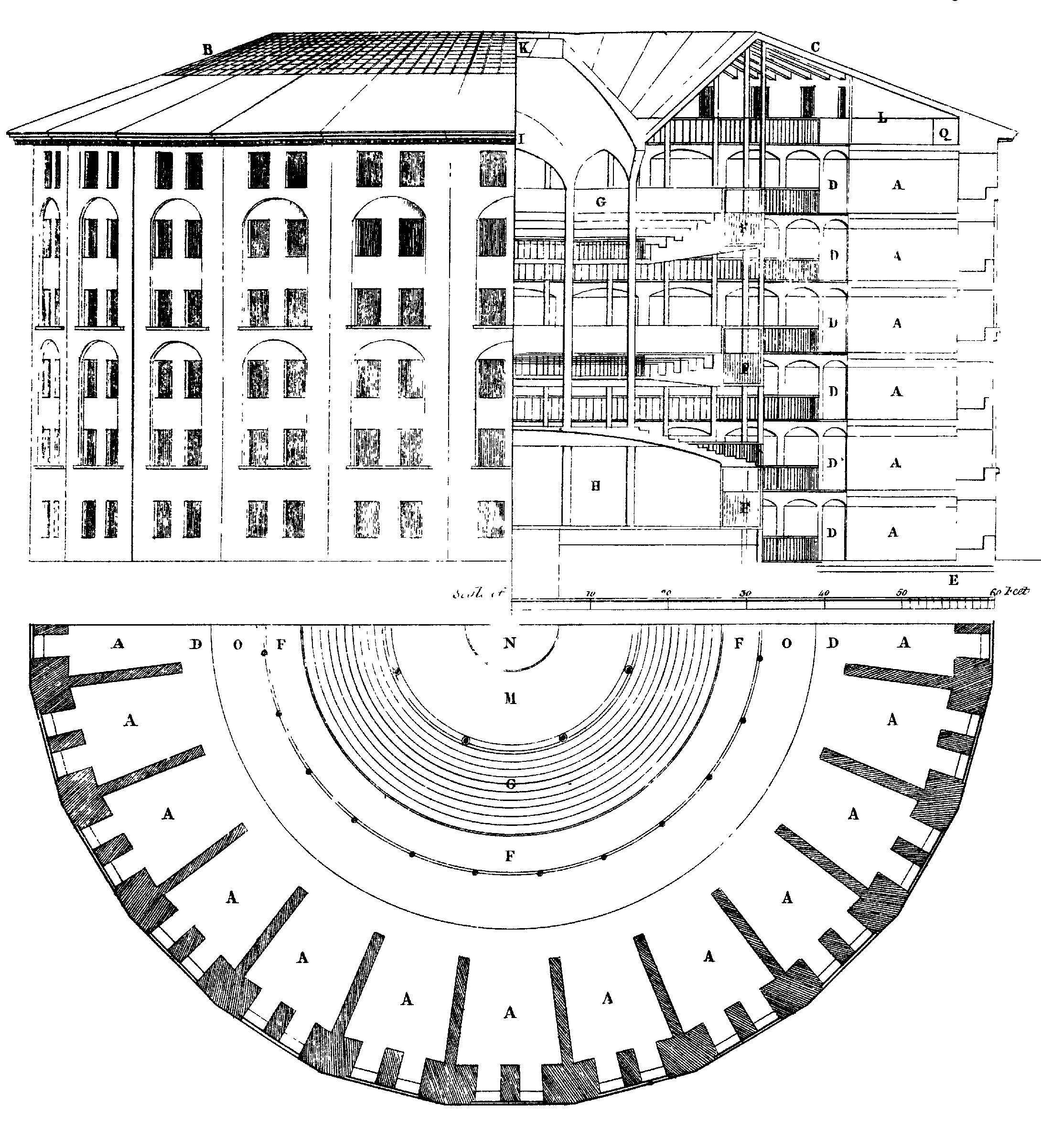
If you didn’t get it yet, I think an experiment to come up with different layouts for Black Rock City is an excellent idea. Bauhaus and the Panopticon have been tried, OK, let’s move on.

3nd attempt-almost final


Screenshot 2016-03-23 17.20.12

[Update 3/23/16 5:53 pm – added images and link to video clip of Burning Man Founder talking about the city design]

Here’s BMOrg’s official position on trying a new city layout, or even incorporating any ideas from Burnenrs. According to them, BRCUP have started a conversation, and we’ll see what happens next. Don’t hold your breath!

We recently caught wind of a Black Rock City Street Plan Design Competition hosted by an experienced group of participants calling themselves the Black Rock City Ministry of Urban Planning (BRCMUP). The Burning Man organization has nothing to do with it, but we thought, hey, this could be fun to watch. And then an architecture blog called ArchDaily wrote about the competition on August 16 without doing its journalism homework, so now we have to clear a couple things up.

Burning Man is not involved with this competition, and we aren’t “select[ing] a winner”. The BRCMUP organizers never said we were, either. They say they’ll present their winner to us, and then it’s up to us what we do with it. So the ArchDaily blog post was in error, and it has since been corrected.

As for the contest itself, the official description is worded pretty strongly:

“The final choice of design will rest with bmorg [sic] based on a combination of popularity, logistics and space considerations (including the option to retain the current city plan).”

We love the ingenuity of Burners and are curious to see what they come up with through this competition. We will certainly take a look at all the top designs in this competition, not just the winner, out of curiosity and admiration. The ideas generated by this competition could also be useful to Regional Events, which are in various stages of growth and planning, each with their own location’s design challenges, and we think that’s great. But there are no plans to redesign Black Rock City.

Thanks to BRCMUP for starting an interesting conversation, and we look forward to seeing what comes of it.

[Source]

So, we started an interesting conversation. And so far 72 designs have been submitted. The designs show just how much unbelievable talent is available for BMOrg to tap into, if they truly chose crowd-sourcing, participation, civic responsibility, immediacy, and communal effort as their path.

You can view randomly chosen designs from the gallery and enter the competition at Black Rock City Ministry of Urban Planning. Seems to me that would be a much better official Ministry for BMOrg to have than their only one so far: Propaganda.

Let’s discuss these ideas. Many of them don’t even require the 0.666% of a circle pentagram design to change.

2013 double pentagram

Or, even better than just talking: put on parties based on those designs and we’ll promote them here and go check them out.


Follow the Money [Updates]

If you thought this year’s theme of “Da Vinci’s Workshop” and the corresponding shift of Propaganda Minister Will Chase over to the Maker Movement meant that 2016 was going to be all about 3d printing, laser cutting, computer-controlled manufacturing, nanomaterials, and all of the exciting things going on in Silicon Valley with the built environment…think again.

So far, it seems, it’s all about money.

We’re not quite 10 weeks into the year, and already we’ve had:

Art, Money and the Renaissance: Re-imagining the Relationship

What Powered the Renaissance? (Could it Have Happened Without Cash?)

The Renaissance’s $ecret Weapon for Arts Funding

How Burners are Re-Inventing the Artists Workshop (answer: “fronted by a master and funded by a relatively small group of wealthy clients”)

And now, Larry Harvey’s latest post “Following the Money: the Florentine Renaissance and Black Rock City”

Is it just me, or is there a bit of a “theme within a theme” starting to emerge here?

In the new post, Larry likens BMOrg spending $1.2 million in art grants to Lorenzo de Medici taking notice of the young man Michelangelo and moving him into his palace to get intimate, or Peggy Guggenheim sponsoring Jackson Pollack.

When Lorenzo de’ Medici adopted the young Michelangelo into his family, he did much more than hire on a hand to serve his needs. Private patronage is personal; it is immediate and intimate, and what is true of Florence and our temporary city is also true of every celebrated art scene ever known. One example is the relationship of a famous heiress, Peggy Guggenheim, and Jackson Pollack, a struggling painter. Peggy paid the painter’s daily bills, bought his work when no one else would, and organized his first art show. At a soirée held in her home, she even let him pee in her fireplace (though not on the carpet)…

…Money sluiced through the streets and piazzas of Renaissance Florence, and yet the sheer hydraulic force of capital did not determine every outcome. Money was a means, but not an end. What mattered most was social interaction in the context of a networked culture driven by ideals, and Burning Man may be regarded in a similar light. One way to fathom this phenomenon is to follow the money. In 2016, Black Rock City will distribute 1.2 million dollars to artists in the form of honoraria.

It is around 3% of revenues – almost exactly half this year’s $2,349,000 Vehicle Pass take.

Artists have been asking for a fair and equitable contract. Here at Burners.Me, we have been suggesting more should be spent on art than on lawyers. It doesn’t sound like Larry & Co are listening to either of these groups, so we wonder where the feedback he’s getting is coming from – and if his information diet is being distorted and propagandized as it moves up the food chain.

In the case of Burning Man, such quasi-governmental patronage does not exhaust resources that are devoted to art. As with competitions sponsored by the Wool Guild, Black Rock City’s honoraria are awarded by a small committee, but this curatorship, as practiced by a few, is counter-balanced by a radically populist patronage. Each year many artist groups will subsidize their projects through community fundraising events and crowd-sourced campaigns on the Internet. Some critics say that Burning Man should shoulder all of these expenses, but we have found that self-initiated efforts create constituencies, loyal networks that support these artists on and off the playa.

This has produced a flow of art that’s issued out of Black Rock City in the form of privately commissioned work, civic installations, and exhibitions subsidized by festivals. Now this surge of money in support of art is going global.

[Source: Burningman Journal]

Radically populist patronage? Sounds like Sanders and Trump voters.

I would love to see a link to somewhere on the Internet where somebody said that BMOrg should pay all the costs of all the art at Burning Man. I think the general consensus here has been that they should pay more of the costs than a third of the pieces they promote the crap out of and claim credit for – and they should probably pay for The Temple, the same way they do for The Man.  Let us spend our artist funding budget supporting pieces that wouldn’t otherwise get there, rather than mega-works you can promote with Oprah and Dr Phil and sell tickets to for $1207+ for spectators to come and behold.

Here is a recent link to Larry Harvey repeating his oft-told tall tale that “no artist has ever signed their art at Burning Man”. This previously espoused philosophy seems to be the antithesis of his latest claim, that the art at Black Rock City funded by their annual Medici donation of $1.2 million (by year BM30) has enabled outside careers and markets for its artists. Personally, I believe the latter to be closer to the truth, and his earlier claim to be false. Nice to see you coming round, Larry.

Last year, in an interview with Ignite Channel, BMOrg were claiming to have created their own art market.

So instead of trying to cater to the traditional art market, Burning Man has created its own. The Burning Man Project not only funds art projects shown at the festival itself, but supports artists creating interactive projects in cities internationally. 

Many cultural festivals have since followed Burning Man’s example in putting art front and center. With pride, Harvey shares: “Many people come [to Burning Man] for the art and stay for the community. (…) We are making it more possible for artists to sell their art in such a way that they can live off their art.” By supporting artists who would otherwise struggle to gain recognition in the traditional art market, Burning Man and other festivals are giving birth to creative dreams while shining a light on unlikely art.

“Anybody who’s going to take art as a vocation has to endure enough. Artists deserve to make a living.” — Larry Harvey

https://vimeo.com/124528604

I would be interested to hear the opinions of some Burner artists about this. Has BMOrg helped them to live off their art? Last we heard, BMOrg’s artist contract specifically forbade artists from paying themselves anything from the art grant. It also said BMOrg take a 10% cut if the art piece is sold off-Playa.

Are they going to claim credit, and a cut of the money, for this? If you ask me, the credit and the money should all go to Marco.

Bliss-Dance-Marco-Cochrane-web_t1000

Artist Marco Cochrane with Bliss Dance, now in front of the MGM at Park Las Vegas. Image: MGM Resorts

[Update 3/13/16 11:55pm]

A reader has let us know that the reason the art grants have “increased” from $850k to $1.2m in the last couple of years is that the costs of The Man are now being lumped together with Art Honoraria grants.


[Update 3/13/16 5:42pm]

Here’s what BMOrg said last week:

Burning Man Arts is funding BRC art to the tune of $1.2 million this year, including these Honoraria recipients, as well as the sculptures, the bell towers, and the 33 Guild Workshops in the Piazza around the Man.

The sculptures? Meaning, The Man and his rotating clock frame? Or other sculptures as well as the Man and the Temple?

The $ are also funding blacksmithing collective Iron Monkeys, linked to BMOrg Board member Kay Morrison, to provide a functioning blacksmith shop in the desert:

There will even be a functioning, participatory blacksmith shop — the Piazza de Ferro — built by the Iron Monkeys. Sparks will fly!

What further indications do we have that the $1.2 million BRC art budget is funding The Man, as well as everything else listed and fractional funding of 60 art projects?

In the most recent financial information we have for the Burning Man Project (2014) the Man and platform can be found at the bottom: $407,055 for Cargo Cult and $237,581 for Fertility 2.0. It’s hard to imagine that 2014’s 120 foot-high Man cost much less than this to construct.

As you can see, in 2014 the Man and Platform are no longer being listed as a separate line item (Donations to Schools and Regionals have also disappeared). Are they office expenses? Contractors has risen $2 million from 2013 to 2014, neatly mirroring a drop in (estimated) profit after all expenses from $4 million to $2 million. Perhaps it could be hidden away in there – but, why?
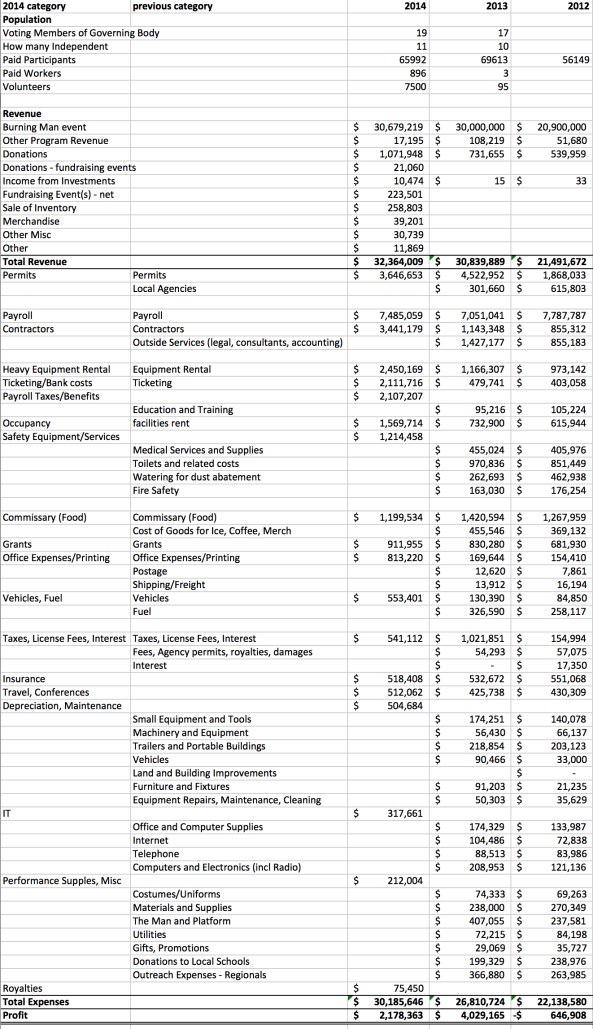
2014 bmp comparison financials 2013 2013 burnersdotme 2