Can LSD Make You A Billionaire?

"Shitty Acid", by artist Brian Lewis Saunders

“Shitty Acid” by Brian Lewis Saunders

Who wants to be a billionaire?

Just eat acid. That’s all you gotta do. If you believe CNN, that is…

Cult leader Lifestyle Guru Tim Ferriss shares his thoughts on using drugs to expand consciousness as an acceptable way for the tech industry to solve problems.

“using smart drugs is like pouring gasoline on the fire. Hallucinogens used very very intelligently help you decide where to put the fire”

Silicon Valley are now promoting hallucinogenic drugs on CNN. Is it time to legalize yet?

“psychedelics have a rich history in Silicon Valley. One of the most iconic users? Steve Jobs” 

Other iconic users include Douglas Englebart (inventor of the mouse and desktop interface), John Gilmore (co-founder of Sun Microsystems and the MAPS association for psychedelic studies), and Stewart Brand (founder of the Whole Earth Catalog and the WELL).

The Billboard Liberation Front was one of the San Francisco groups that seeded Burning Man

The Billboard Liberation Front was one of the San Francisco groups that fed into the early Burning Man. This art piece was produced by John Gilmore, and “dropped” in 1995

Author Ryan Grim sees Burning Man as the latest incarnation of Silicon Valley’s desire to be inspired by hallucinogens.

wired 1996Burning Man co-founder Danger Ranger, contributed to Mondo 2000’s Berkeley party house and got wired with WIRED. He attributes hanging around with this crowd (with their Stanford chemistry lab supply) as providing valuable “connections” to Burning Man that brought the tech crowd in to join up with the Cacophony Society’s Merry Pranksters. WIRED beat the drum for the tech industry with their Bruce Sterling cover story in 1996. Danger Ranger joined the Burning Man Project in 1990, prior to that with John Law he was a co-founder of the Cacophony Society, which grew out of their earlier involvement in the Suicide Club, which also begat the BLF. The Billboard Liberation Front “dropped LSD” in 1995, sponsored by Gilmore as the project’s Creative Director. First a giant neon ad for LSD, next to the freeway, ironically high-jacked by art guerilla cyber punks; next, a cover story on WIRED with a neon glowing Burning Man and a Mad Max-themed video from Dr Dre.

Even LSD mega-promoter Timothy Leary got all Cyberdelic, saying that the PC is the LSD of the 1990’s and admonishing Bohemians to turn on, boot up, jack in“. Presumably, in the 21st century the LSD of the Teenies is going to be Oculus Rift and the Burner-built Microsoft Holo Lens, where you can plug into Burner-built Second Life to attend Burning Man virtually at their Burn2 Regional.

From Wikipedia:

cyber punk maskTimothy Leary, an advocate of psychedelic drug use who became a cult figure of the hippies in the 1960s, reemerged in the 1980s as a spokesperson of the cyberdelic counterculture, whose adherents called themselves “cyberpunks”, and became one of the most philosophical promoters of personal computers (PC), the Internet, and immersive virtual reality…


In contrast to the hippies of the 1960s who were decidedly anti-science and anti-technology, the cyberpunks of the 1980s and 1990s ecstatically embraced technology and the hacker ethic. They believed that high technology (and smart drugs) could help human beings overcome all limits, that it could liberate them from authority and even enable them to transcend space, time, and body. They often expressed their ethos and aesthetics through cyberart and reality hacking.

steampunk mask 2R. U. Sirius, co-founder and original editor-in-chief of Mondo 2000 magazine, became the most prominent promoter of the cyberpunk ideology, whose adherents were pioneers in the IT industry of Silicon Valley and the West Coast of the United States 

io9 has a list of 10 great inventors who took drugs. At least 6 of the 10 were trippers:

6. Steve Jobs — LSD
LSD was a big deal for Steve Jobs. How big? Evidently, Jobs believed that experimenting with LSD in the 1960s was “one of the two or three most important things he had done in his life.” What’s more, he felt that there were parts of him that the people he knew and worked with could not understand, simply because they hadn’t had a go at psychedelics. This latter sentiment also comes through in his recently-published biography, wherein Jobs goes so far as to associate what he interpreted as Bill Gates’ dearth of imagination with a lack of psychedelic experimentation:

“Bill is basically unimaginative and has never invented anything, which is why I think he’s more comfortable now in philanthropy than technology. He just shamelessly ripped off other people’s ideas.”

“He’d be a broader guy,” Jobs says about Gates, “if he had dropped acid once or gone off to an ashram when he was younger.”

5. Bill Gates — LSD
Which is funny, because Bill Gates totally did experiment with LSD, though an excerpt from a 1994 interview with Playboy reveals he was much less open about it than Jobs:

PLAYBOY: Ever take LSD?
GATES: My errant youth ended a long time ago.
PLAYBOY: What does that mean?
GATES: That means there were things I did under the age of 25 that I ended up not doing subsequently.
PLAYBOY: One LSD story involved you staring at a table and thinking the corner was going to plunge into your eye.
GATES: [Smiles]
PLAYBOY: Ah, a glimmer of recognition.
GATES: That was on the other side of that boundary. The young mind can deal with certain kinds of gooping around that I don’t think at this age I could. I don’t think you’re as capable of handling lack of sleep or whatever challenges you throw at your body as you get older. However, I never missed a day of work.

Francis Crick — LSD

Francis Crick — of the DNA-structure discovering Watson, Crick, and Franklin — reportedly told numerous friends and colleagues about his LSD experimentation during the time he spent working to determine the molecular structure that houses all life’s information.

In fact, in a 2004 interview, Gerrod Harker recalls talking with Dick Kemp — a close friend of Crick’s — about LSD use among Cambridge academics, and tells the Daily Mail that the University’s researchers often used LSD in small amounts as “a thinking tool.” Evidently, Crick at one point told Kemp that he had actually “perceived the double-helix shape while on LSD.” 

Read the full list at io9.com.

As the Guardian points out, many people tried acid, but only one became Steve Jobs. Similarly, although many Burners take acid, less than a tenth of one percent are Billionaire Burners.

Taking LSD can make you lose your mind, like Pink Floyd’s Syd Barrett who was a frequent acid tripper, and never recovered from one particularly large dose. In her brief article Operation Chaos, Mae B Russell  suggests that rather than coincidence, this may have been a deliberately engineered capability of the drug which was developed during World War II as a chemical weapon. LSD was researched by the military/intelligence complex for many decades, distributed for in hundreds of millions of doses (often gifted), and synthesized into many more variants than just “LSD-25”.

The whole acid scene began in Silicon Valley, and disseminated out of the Bay Area into Hollywood and then the rest of the world. How many of San Francisco’s Summer of Love Sixties hippies became billionaires? There are definitely a few. For every self-made billionaire in the Bay that did drop acid, there are many more who did not. Acid cannot make you a billionaire any more than going to Burning Man can make you a billionaire.

Mondo 2000’s original cyberpunk R U Sirious now looks back on the cyberdelic revolution rather ruefully:

Everything from Wetware to Techno Erotic Paganism image: Gord Fynes/Flickr (Creative Commons)

Everything from Wetware to Techno Erotic Paganism image: Gord Fynes/Flickr (Creative Commons)

Anybody who doesn’t believe that we’re trapped hasn’t taken a good look around. We’re trapped in a sort of mutating multinational corporate oligarchy that’s not about to go away. We’re trapped by the limitations of our species. We’re trapped in time. At the same time identity, politics, and ethics have long turned liquid. […] Cyberculture (a meme that I’m at least partly responsible for generating, incidentally) has emerged as a gleeful apologist for this kill-the-poor trajectory of the Republican revolution. You find it all over Wired – this mix of chaos theory and biological modeling that is somehow interpreted as scientific proof of the need to devolve and decentralize the social welfare state while also deregulating and empowering the powerful, autocratic, multinational corporations. You’ve basically got the breakdown of nation states into global economies simultaneously with the atomization of individuals or their balkanization into disconnected sub-groups, because digital technology conflates space while decentralizing communication and attention. The result is a clear playing field for a mutating corporate oligarchy, which is what we have. I mean, people think it’s really liberating because the old industrial ruling class has been liquefied and it’s possible for young players to amass extraordinary instant dynasties. But it’s savage and inhuman. Maybe the wired elite think that’s hip. But then don’t go around crying about crime in the streets or pretending to be concerned with ethics

For a true “rich history of psychedelics in Silicon Valley”, a good introduction is John Markoff’s “deliciously scandalous” book What The Dormouse Said:

markoff dormousetechnology never happens in a vacuum. The book was an effort to try to pin down how personal computing first emerged around the Stanford campus at two laboratories in the 1960’s: one was run by John McCarthy, and was called the Stanford Artificial Intelligence Laboratory; and the other was run by Doug Engelbart and known as the Augmentation Research Center or the Augmented Human Intellect Research Center. Before there was Xerox PARC, which most people know about, and before the two Steves (Steve Jobs and Steve Wozniak) in the garage creating the Apple computer, many of the technologies that became the personal computer were developed in these two laboratories on either side of the Stanford campus during the 1960’s. I tried to capture that work and the environment in which it took place, which was deeply influenced by the 1960’s counterculture and by the anti-war movement. [Source: Ubiquity]

image: Trey Ratcliff/Flickr (Creative Commons)

image: Trey Ratcliff/Flickr (Creative Commons)

image: Kordite/Flickr (Creative Commons)

image: Kordite/Flickr (Creative Commons)

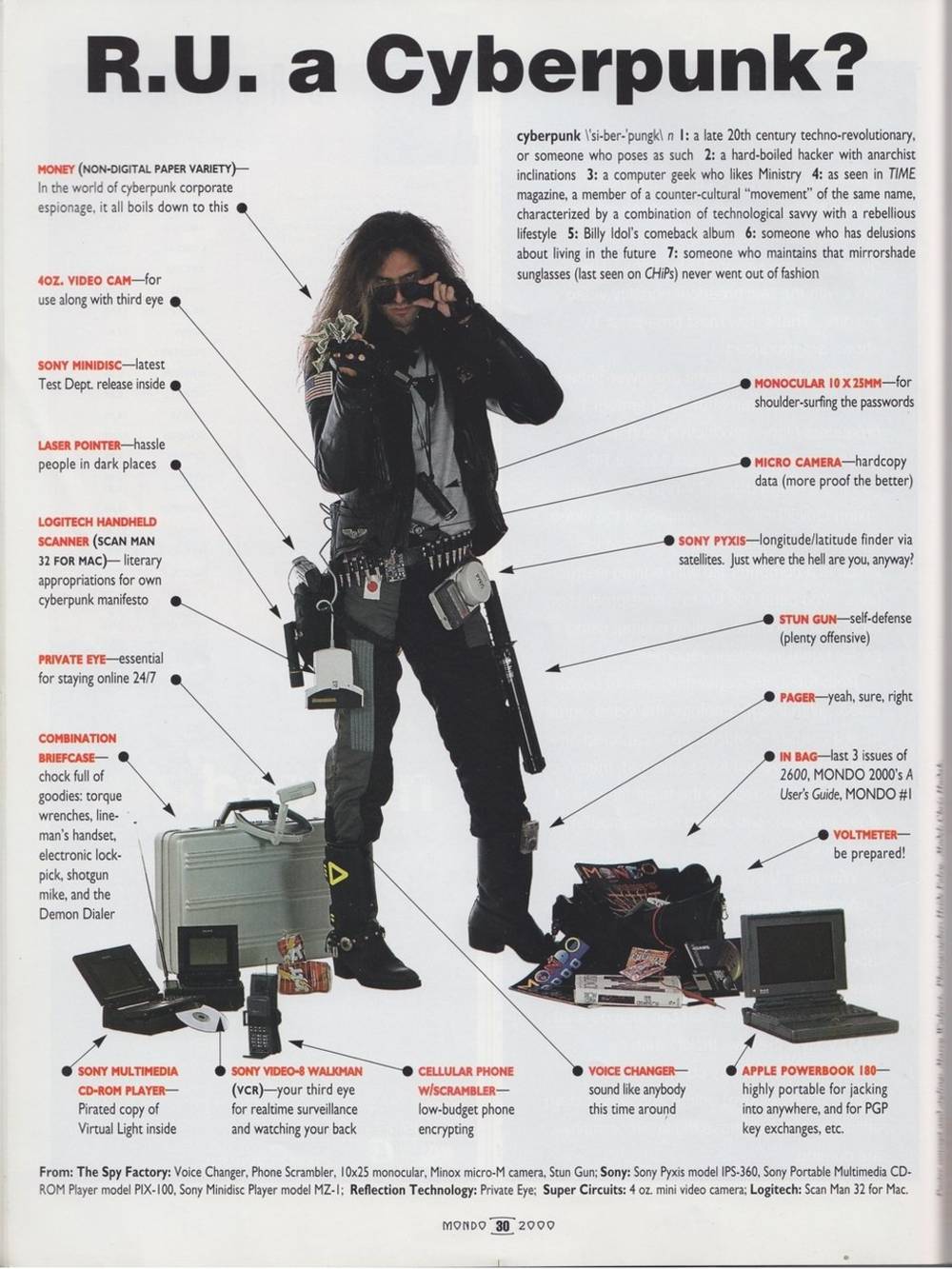
http://craphound.com/images/R_U_cyberpunk.jpg

Peaceful Warriors, Hackers and Merry Pranksters

Dr Bruce Damer (L), Joe Rogan (R)

Dr Bruce Damer (L), Joe Rogan (R)

A couple of months ago, I was listening to the Joe Rogan podcast, and heard an amazing tale from Burning Man. Joe, who is a very public advocate for hallucinogenic drugs, was interviewing Dr Bruce Damer, a long time Burner (’99). He was recommended as a guest for Joe by Dennis McKenna, whose brother Terence was called the Patron of Psychedelic Drugs in his New York Times obituary – Timothy Leary called him “the Timothy Leary of the 90’s”.

Dr Damer, a technologist and virtual world pioneer, gives seminars at the Pentagon, as well as lecturing Burners on psychedelic drugs.

They kick the podcast off with the “craziest story of all time”, which Bruce Damer originally told to Boing Boing, about being at Burning Man during Hurricane Katrina and hacking into military/intelligence satellites to watch the action:

JR: “You were partying at Burning Man with people who work at the Pentagon”

BD: “Yes”

JR: “That gives me great discomfort, to know that people who work in the Pentagon are partying at Burning Man”

BD: “Rocking! We called for Blackhawks…

Our camp was doing the Wi-Fi for the public and emergency networks, the private network…we had a dish, so we could take over satellites. One of our guys took over a recon satellite from the National Reconnaissance Office. He took this thing offline – this was a Pentagon move…Our Pentagon satellite phone rang, the general on the other side was saying “what’s going on” and then instructed the guy not to answer. We then had control of this satellite and could watch Katrina come in. The government wasn’t doing anything to help people, with all this equipment.

He worked on the Asian tsunami relief efforts, then he went straight to Afghanistan, then he went to Baghdad, then he came to Burning Man.

He works under Title 10 money doing extreme comms, extreme emergency relief efforts. This guy’s invented all this technology, cellphones in rubberized cases that come down on parachutes and run for a month… Here we have a natural disaster happening in our own country, barreling in. Nobody at Burning Man knows it’s happening, but we watched it come in.

You could watch video from orbit on this guy’s screen. You could watch people walking…we saw the first levee breach on this guy’s screen at Burning Man…hi-res reconnaissance imagery…the Iridium phone kept ringing. This is an innovative genius type guy that is totally respected in that organization. The general that initiated the enquiry was covering him, so that the general could then contact Space Command and say “I can’t get any information”. He had put the satellite in some kind of failsafe fall-back mode, so they would spend the next several days trying to get back into it…we could burn hydrazine and locate stuff on the Playa.”

Bruce then goes on to discuss billionaire camps with sherpas. It’s the first seven minutes here:

The whole podcast is worth listening to. Dr Damer gave a lecture at Burning Man in 2012 about shamans, the Pentagon and NASA at the Palenque Norte Psychedelic Salon.

The Palenque Norte journey began with the legendary Entheobotany Conferences held at the Chan Kah hotel near the ancient Mayan ruins just outside of Palenque, Mexico. There, Terence McKenna, Jonathan Ott, Ann & Sasha Shulgin, and a host of other psychedelic luminaries passed along many insights, discoveries, and wild tales to the fortunate Tribe members who were there. And it was at the end of the pool where Terence McKenna gave some of his last talks at the Chan Kah. Years later, then in 2003, a few alumni from those conferences decided to have a “Palenque reunion” at the Burning Man Festival, and so they organized a lecture series to continue the Palenque tradition.

https://vimeo.com/57887303

Bruce Damer takes the 2012 Palenque Norte audience at the Burning Man Festival on a far flung journey into what he calls his practice of “global multi-cultural, multi-ethnic, multi-technic shamanism” where you “put yourself on the shelf” and dive deeply into the worlds of Pentagon think tanks, NASA mission designers, the tribal cultures of Pakistan, the Swiss [bankers], Egyptologists, IT professionals, and Christian Evangelicals, to come back with the true alchemical gold. With apologies to Terence McKenna, he says “there is no dominator culture” and that if we aren’t careful we can collectively fall for cartoon epistemologies, chase chains of weaker and weaker claims, and become a victims of our own delusions, and fall prey to others’ unsubstantiated theories. Bruce advises everyone to become their own best skeptic and develop “critical intelligence”. If someone says something that strikes you as flaky or just doesn’t feel right, Bruce suggests that you think it through before you pass on their meme.

Great pants!

So this is the type of people at Burning Man. It’s not all drugged up hippies looking for an orgy. Some of them advise the Pentagon and NASA. Some of them can hack military/intelligence satellites, and get Generals to cover for them. Former Supreme Allied Commander of NATO, General Wesley Clark, is now a Burner. He ran for President, as did Denis Kucinich who attended for the first time this year.

Burning Man takes place on former military land. Many of the people who played key roles in its early years have a military/intelligence background.

Blackhawks on the Playa would not have been a big deal. Every year, military aircraft fly overhead. It is close to Naval Air Station Fallon.

Blackhawk military helicopter hovers low over Burning Man, 2013

Blackhawk military helicopter hovers low over Burning Man, 2013. Image: Patrick Roddie

blackhawks christopher olewnik

image: Christopher Olewnik/Facebook


christopher olewnik

image: Christopher Olewnik/Facebook


Other aircraft spotted flying over Burning Man over the years include Chinooks, F-14’s, F-16’s, F-18’s, F-22’s, C-130’s, even a flight of V-22 Osprey tilt-rotors.

Pacific Standard magazine published a great story last year by Brian Calvert, The Merry Pranksters Who Hacked The Afghan War, about the Synergy Strike Force – Burners who have serious juice in the military/intelligence world.

SYNERGY STRIKE FORCE BM LOGO

recognize anything familiar in this patch?


Their leader, Dr Dave Warner, is described as:

a former U.S. Army drill instructor, self-avowed “hippie doctor,” PhD neuroscientist, technotopian idealist, dedicated Burner, dabbler in psychedelics, insatiable meddler, and (weirdest of all) defense contractor.

From PSMag.com:

For a long time, the Taj Guest House was about the only place you could get a beer in Jalalabad. The provincial capital, about 30 miles from the infamous mountains of Tora Bora, has been the main staging ground for U.S.-led forces in the eastern part of Afghanistan since the early days of the war. When I showed up in the city in November 2011 to report on the propaganda efforts of a franchising Taliban, I found myself at the Taj. There wasn’t much to the pub—just a bamboo-covered bar, a fireplace, a glass-fronted cooler with some Heineken stacked inside, and a few bottles of vodka and other spirits lined up under the red glow of a lamp.

Plus there was an odd little sign: “We share information, communication, (and beer).”

…Looking like a cross between a mountaineer and a mathematician, he had a salt-and-pepper beard and curly hair that hung down to his shoulders, and he favored a uniform of black polo shirts over tied-dyed tees. His name was Dr. Dave Warner.

War zones attract a lot of sketchy characters. In Afghanistan and Iraq, where defense contractors have generally outnumbered soldiers on the ground, the cast of extras has been especially sprawling and inscrutable—security experts, mercenaries, aid workers, engineers, intelligence types, and consultants of every kind. It was just a guess, but given the array on the roof, I took Warner and his team for spooks of some kind.

I was at best half right in my guess about Warner’s occupation. He did indeed work for U.S. intelligence sometimes, he explained, but he wasn’t a spy. On principle, he refused to get a security clearance, out of a belief in something he called “radical inclusion.” The most valuable information in a conflict or disaster zone, he said, was information that could be shared with everybody.

image: Graham Smith/PSMag

image: Graham Smith/PSMag

The term radical inclusion stopped me. I recognized it from the summer of 1998, when I had gone to Burning Man, the hedonistic-fire-worshipper-art-festival that occurs every summer in Nevada’s Black Rock Desert. Radical inclusion is one of the event’s “Ten Principles.” When I mentioned this, Warner’s eyes lit up. He dug into his T-shirt and pulled out a shining Burning Man medallion. “Dude,” he said, grinning in the firelight. “This is a Burner bar.”

Warner’s entire team – which he called, in all seriousness, the Synergy Strike Force—had just attended Burning Man that summer. He himself had been attending annually since 2002. And the bar, it turned out, was his bar…It was not only a place to drink and flop but also a kind of grand social experiment—an outpost of the Burning Man ethos in the Afghan desert

The war effort, in short, was sophisticated when it came to deploying lethal hardware like drones, but clumsy in just about every other way. A few people in the upper echelons of the command structure were painfully aware of this. Warner knew because he had their ear. He had connections in the Defense Intelligence Agency, the CIA, the Army Special Forces, and the Office of the Secretary of Defense. He also knew what an unlikely figure he cut—a Burner among bureaucrats. When I asked him later why the Department of Defense had turned to him, he shook his head and laughed. “Oh,” he said, “they’re fucking desperate.”…

Eric Rasmussen, one of Warner’s early sponsors at DARPA, has come away similarly awed by the doctor’s capacities. “I was taught by multiple Nobel Prize winners, and Dave is the equal of any of them in intelligence,” Rasmussen told me. Warner has been “trendsetting for a number of very forward-thinking organizations, like the Strategic Studies Group for the Chief of Naval Operations, like DARPA, like the Office of Naval Research,” among others. “He has shaped curriculum for the Marine Corps. He has influenced curriculum for National Defense University. He is a remarkable intellectual force who has managed to hold on to his idealism through everything.” What’s more, he has done it all without a security clearance. “And that,” Rasmussen said, “if you remember the kind of work that he does—and for whom—is astonishing.”…

I was just beginning to get used to his way of talking, which alternated between turgid military jargon and gonzo flights of fancy. (“I’m dismantling the Death Star,” he told me later, “to build solar ovens for the Ewoks.”)…

The group was also engaged in various maker-ish side projects worthy of Burning Man. Gold was busy building a methane generator from PVC pipe and an old oil drum. The design, popular among self-sufficiency buffs on the Internet, allows you to filter the gasses that come off human waste into pure methane, which can be used as a fuel source…

Last summer at Burning Man, members of the team gathered once again, and Warner invited me to join them. So I headed out to the Black Rock Desert and pitched a small tent next to Warner’s giant RV. He came out of nowhere, from the dust and the wind, as I was struggling with some rigging for a tarp. He was drinking a beer, wearing a tied-dyed shirt and cutoff jean shorts, with a tie-dyed bandana on his head and another around his neck. “We’re going to the temple,” he said, “for a service.”…

Warner gathered with other members of the Synergy Strike Force. He nailed a pakul hat to the wall, hung an Afghan scarf around it, and added a Synergy Strike Force patch. Around us, Burners wept and prayed. And at the end of the festival, the temple was burned to the ground, with everything in it.

Read the full story here, it’s a great read. Dr Dave Warner sounds like a hero to me. Definitely in the running for the “best Burner” prize.

Here are some links to other stories about the Synergy Strike Force:

WIRED (2012): Cash, Time Run Out for Afghanistan’s Wi-Fi City

Synergy Strike Force Handbook – Public Intelligence Blog

Who’s Who in Peace Intelligence

Human Geography: Dave Warner’s photos from Afghanistan

Their online hub, with links to many more photos, is at reachback.org

Image:  Peretz Partensky/WIRED

Image: Peretz Partensky/WIRED

Peace Intelligence. That seems like something that the world could use a lot more of. Sadly, the Synergy Strike Force’s Afghanistan operations have now stopped, due to lack of funding (they needed about $5,000 a month for their Internet connection). Now THAT would have been a good use of the non-profit Burning Man Project’s $30 million annual budget.

synergy strike force we came we shared we cured

Susan Sarandon Talks Burning Man, Bowie and Brownies

balancevilleLast year my Burgin sister and I watched the Cargo Cult burn from on top of BalanceVille, an art car sleigh that raises 52 feet in the air with a scissor lift. Next to us, with a small blinky light in her hair, was Academy Award winning actress Susan Sarandon. She was super chilled, not an uppity celebrity in any way – and loving it.

“People made art for no benefit — it was made just for the interaction of it all,” Sarandon said. “People came and built huge statues and temples and all kinds of things. After a week, they take it down and it’s just gone . . . it was interesting because it was nice to see art that was created without any commerce.”

She’s just done a great interview with the Daily Beast, talking about Burning Man, psychedelics and her past love affair with The Thin White Duke.

From the Daily Beast:

Susan Sarandon is a total freak of nature—and I mean that in the best way possible. One of the biggest issues plaguing Melissa McCarthy and co. on the set of the recent film, Tammy, was how the hell to make the stunning 67-year-old actress look, well, not so stunning. “Susan looks too good!” the cinematographer complained ad nauseam, according to McCarthy. “Susan seems to be glowing from within.”

In person, you can see why it proved such a gargantuan task. Few actresses—nay, people—have bitch-slapped Father Time quite like Sarandon. Combine those age-defying looks with stellar acting chops and a no-bullshit attitude and you’ve got a woman who marches to the beat of her own drummer—dating thirtysomethings and remaining prolific in ageist Hollywood.I heard you went to Burning Man last year, but sadly couldn’t make it this year.

Parasols and Celebrities at Cargo Cult

Parasols and Celebrities at Cargo Cult

It’s fabulous. I can’t go this year because my daughter’s having a baby around that time, so I don’t think I’d feel very free to indulge if I was waiting for a message to see if she’s gone into labor. I went all around on a Segway and a bicycle, which was great, and even though people sometimes recognized me and said, “Oh, it’s so cool you’re here!” it wasn’t like walking the streets of New York. The art was amazing. You’ll find fantastical stuff like four-story women, and when the light comes up, a half-naked woman with a parasol. Despite the fact that there was more of a police presence there, it was a lot of fun and I’d definitely go back. 

Did you take any psychedelics? You kind of have to, right?

Well, it’s pretty psychedelic to begin with. But, yeah, I’m not new to the idea of mushrooms. I don’t really like chemical things, really. Timothy Leary was a friend of mine, so that acid was nice and pure, but I’m not really looking for chemicals, and I don’t like to feel speedy. But I’ve done Ayahuasca and I’ve done mushrooms and things like that. But I like those drugs in the outdoors—I’m not a city-tripper. My attitude about marijuana or anything is, “Don’t be stoned if you have to pretend you’re not,” so I’d never do drugs if I was taking care of my kids. I like doing it in the Grand Canyon, or in the woods. You want to be prepared and not have responsibilities. It does remind you of your space in the universe—your place in the universe—and reframe things for you. I think you can have some very profound experiences.

The late Steve Jobs said taking LSD was a very profound experience, and one of the most important experiences of his life.

But it didn’t make him a kinder person. It’s not going to solve all your problems. But, yes, I’m totally supportive of that means to reframe your universe.

And marijuana was recently decriminalized in New York.

It got decriminalized in small amounts. It will be legal everywhere, and that will cause a very interesting tipping point. Certainly, if more people were smoking instead of drinking, people don’t get mean on weed, don’t beat up their wives on weed, and don’t drive crazy on weed. They just get hungry, don’t go out of the house, or laugh a lot. I think it would make for a much more gentle world.

Although edibles are sort of a different ballgame. If I was driving and munching on a brownie I’d stand a really good chance of putting my car into a ravine.

Well, it needs to be treated as a controlled substance in that you don’t give it to kids, and you don’t drive. Certainly, liquor has caused many more deaths. There’s never been a death by marijuana. And the money spent to incarcerate people, the money spent on the drug war, and the fact that cartels are running wild, it’s crazy.

…I got married really young, which knocked out most of my 20s to be fucking around. There have been a couple of famous, pretty interesting ones. One rock star, and another actor. But I’m pretty much a nester and tend to be monogamous.

susan sarandond david bowieWho was the rock star?

Bowie.

Get out. That man is a legend. Did that happen around the time of The Hunger?

Yeah. He’s worth idolizing. He’s extraordinary. That was a really interesting period. I wasn’t supposed to have kids, and I’m the oldest of nine and had mothered all of them, so I wasn’t ever in a mode to where I was looking to settle down and raise a family, so that definitely changes the gene pool you’re dipping into. But Bowie’s just a really interesting person, and so bright. He’s a talent, and a painter, and… he’s great.

susan sarandon geena davis selfie

Follow @susansarandon

Agreed. That Thelma & Louise reunion selfie you took with Geena Davis really broke the Internet.

There was a whole photo session and then they do this interview, and then I just thought, “Let’s take one of us.” It was very spur of the moment. And you know what? My dog tweeted it.

Your dog tweeted it?

Yeah. My dog, Ms. Penny Puppy has a site, and she tweeted it. And we had no idea that it would do that. We had none. It was just a joke!

[read the full interview here]